How to view website from France
 Linus Whitcombe··5 min
Learn practical steps to view websites from France, including VPNs, proxies, DNS tricks, and legal considerations.
the article body in Markdown: an opening paragraph, then 4 to 6 sections that each start with a "## " heading, "### " subheadings where useful, bullet lists, one Markdown table where a comparison helps, and a short final section with the recommendation
Opening paragraph If you want to view websites from France, the most reliable and flexible approach is usually to simulate being physically located there. This can be useful for testing regional content, accessing services that are restricted by geography, or simply browsing a site as it would appear to a user in France. Below are practical methods, how they work, and what to watch out for, with guidance on choosing the right option for your needs.
1. Use a VPN (Virtual Private Network)
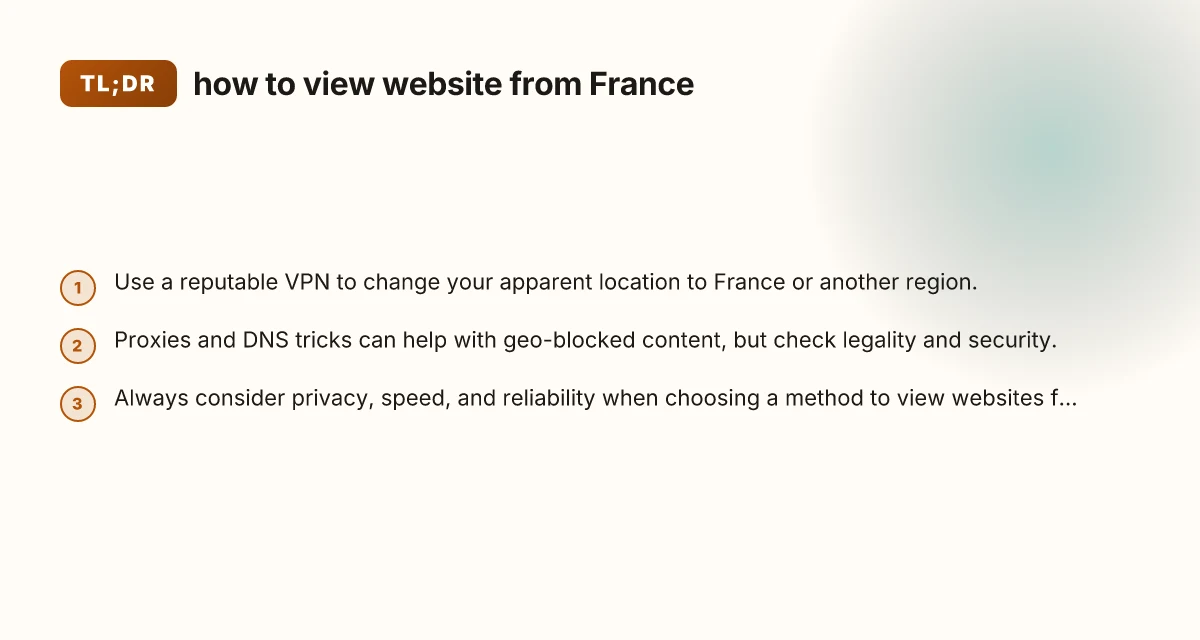
Why a VPN is often the best option
- Encrypts your traffic for security
- Lets you appear to browse from a France-based server
- Works across devices and apps
How to choose a VPN
- Look for servers in France
- Check no-logs policy and privacy features
- Ensure speed, reliability, and good customer support
- Verify device compatibility (PC, Mac, iOS, Android, browser extensions)
How to use
- Sign up with a reputable VPN provider
- Install the app or browser extension
- Connect to a France server
- Open your browser and visit the site
Pros and cons
- Pros: Strong privacy, broad compatibility, stable performance
- Cons: Some websites detect VPNs, potential slower speeds
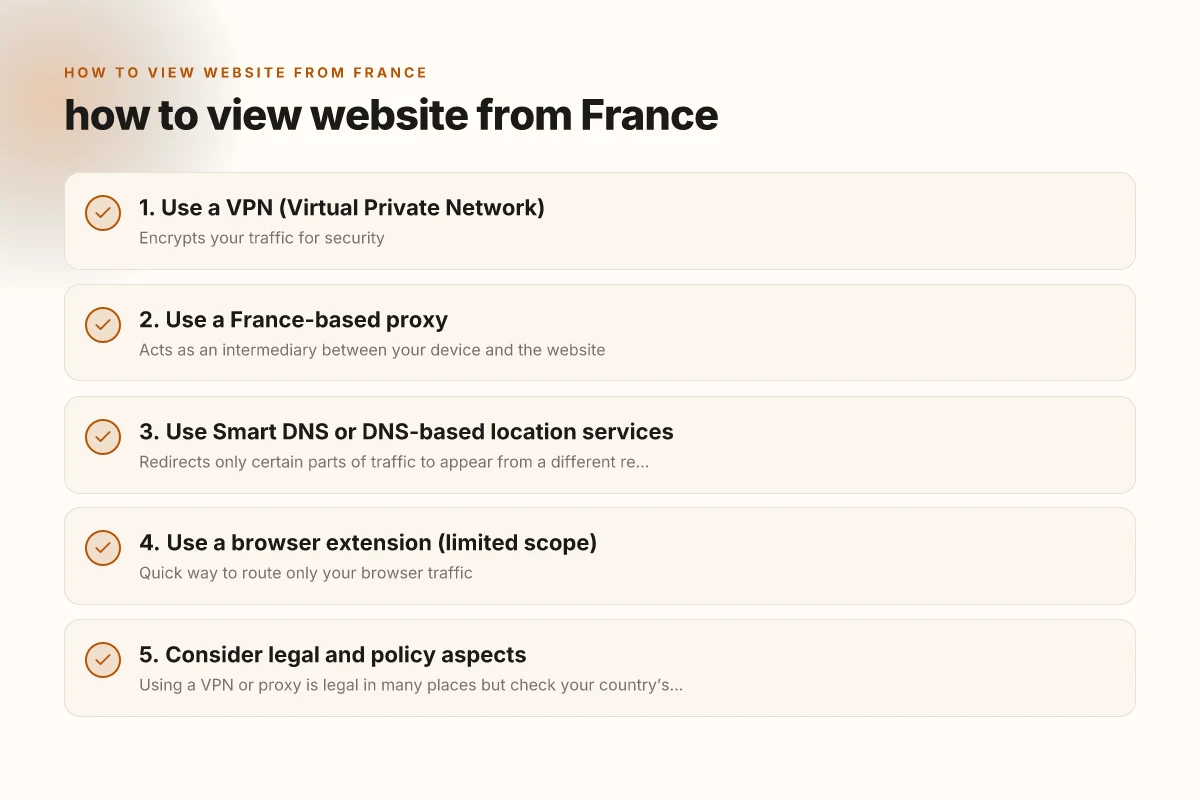
2. Use a France-based proxy
What a proxy does
- Acts as an intermediary between your device and the website
- Can mask your location to appear in France
Types of proxies
- HTTP/HTTPS proxies for browsers
- SOCKS proxies for broader applications
How to use
- Configure the proxy in your browser or system settings
- Enter the France proxy address and port
- Test with a site that shows your location
Trade-offs
- Pros: Sometimes free or inexpensive
- Cons: Security varies, often less reliable, may leak IPs
3. Use Smart DNS or DNS-based location services
What Smart DNS does
- Redirects only certain parts of traffic to appear from a different region
- Usually faster than full VPNs because it doesn’t encrypt all traffic
How it helps you view France-based content
- Access geo-restricted streaming or sites without changing your IP
- Keeps your actual IP visible to most services
Considerations
- Does not encrypt data. Privacy is lower
- Some sites detect Smart DNS and block it
- May require device-specific setup
Quick setup tips
- Sign up with a Smart DNS provider that supports France
- Follow their instructions to configure DNS on your router or device
- Verify by visiting a location-check page
4. Use a browser extension (limited scope)
When extensions help
- Quick way to route only your browser traffic
- Useful for testing or occasional access
Popular options
- VPN extensions with France servers
- Lightweight proxy extensions
Limitations
- Extensions may not cover all apps or devices
- Some extensions are less secure or log data
- Not a full replacement for a system-wide solution
5. Consider legal and policy aspects
What the law says
- Using a VPN or proxy is legal in many places but check your country’s laws
- Some services’ terms prohibit circumvention of geo-restrictions
Service terms and account risk
- Some sites block VPNs or proxies
- Free tools may expose you to malware or data collection
Best practices
- Read terms of service for the site you access
- Use reputable tools with transparent privacy policies
- Avoid sharing sensitive information through untrusted proxies
6. Quick comparison: VPN vs. Proxy vs. Smart DNS
| Method | Primary Use | Speed (typical) | Privacy/Security | Best for | Potential drawbacks |
|---|---|---|---|---|---|
| VPN | Full device/app protection | Moderate to fast; depends on server load | High; encrypts all traffic | Bypassing geo-blocks across apps | Possible blocks by sites; reduced speeds on crowded servers |
| Proxy | Browser or app specific | Often fast | Low to moderate; traffic not encrypted | Quick access to specific sites | IP leaks; limited protection; not foolproof |
| Smart DNS | Accessing geo-restricted content; speed-focused | Fast; no encryption | Low; privacy limited | Streaming or testing regional content | Not encrypted; some sites block it |
7. Practical step-by-step quick-start
- Decide on your goal: general browsing from France or access to a specific service.
- If privacy and broad access are priorities, choose a reputable VPN with France servers.
- If you only need a quick test in a single browser, consider a browser extension or Smart DNS.
- Install and configure your chosen method following official guides.
- Verify your location: visit a site that displays your IP or location (for example, an IP geolocation page).
- Start browsing and monitor performance. If you encounter blocks, try a different France server, switch to another method, or review your setup.
8. Security best practices when viewing from France
- Use trusted providers with transparent privacy policies.
- Enable strong authentication on your accounts connected to the service you’re testing.
- Avoid entering sensitive data on sites you reach through untrusted proxies.
- Regularly update software and extensions to patch security flaws.
- Consider a dedicated device or a virtual machine for testing to avoid cross-device risks.
9. Tools and resources to help you view websites from France
- VPN providers with explicit France server listings and clear privacy policies
- Reputable proxy lists, noting that free proxies are often unreliable and risky
- Smart DNS services with France regions and good customer reviews
- IP geolocation check pages to confirm your apparent location
- Privacy-focused browser settings and extensions that minimize tracking
Final section: recommendation For most people who want to view websites from France reliably and securely, a reputable VPN is the best starting point. It provides robust privacy, broad compatibility, and the ability to access a wide range of services as if you were in France. If you only need to test a single site quickly or want minimal overhead, a Smart DNS or a browser-based proxy can be suitable, but be mindful of privacy and potential blocks. Always choose trusted providers, understand the terms of service of the sites you’re accessing, and use secure configurations to protect your data. If you’re unsure which path fits your needs, consider trying a trusted VPN first, evaluate performance and compatibility, and supplement with other methods only if necessary.