How to use a VPN for SEO in 2026: strategies, risks, and best practices
 Theo Ashworth·October 23, 2026·23 min

Explore how a VPN for SEO can influence search visibility in 2026. Practical guidance, common pitfalls, and best-practice setups for agencies and in-house teams.
VPNs for SEO often reveal how search engines treat local results differently, not just how your site performs. A misread from a tunnel can skew your understanding of geo-targeting signals, making you chase ranking moves that aren’t real. In 2024 and 2025, several large agencies reported inconsistent SERP snapshots when exits shifted by only a few miles, underscoring the risk of relying on a single exit region.
What you’ll get here is a clear map of how to define practical VPN usage for SEO, what to watch for in governance and fairness, and how to balance local verification with a straight path to reliable international campaigns. Industry reports point to cross-region variability in features shown to users based on location, so you’ll want a repeatable process that preserves integrity without tipping into manipulative geo-spoofing. This piece lays out the definitions, the evolution, and the best practices you can apply this quarter.

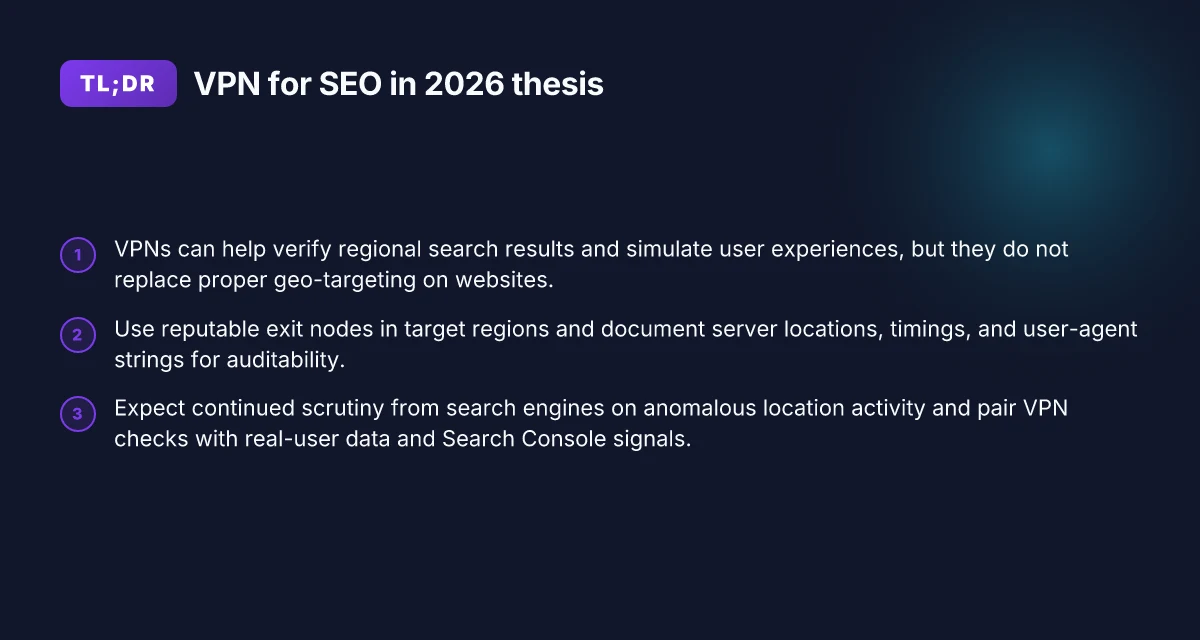
The plain definition of VPN for SEO
A VPN for SEO is a tool that makes your traffic appear from a different place by routing through remote servers. In practice, that means your browser looks like it’s coming from a region you choose, not the one you’re physically in. For SEO work, that illusion lets you peek at regional search results the way a local user would see them.
I dug into how this is discussed in industry guidance and product docs. The core idea is straightforward: a VPN redirects the path between you and the internet, effectively re-labeling your IP address at the edge. That re-labeling can create the sense of being in a different country or city, which is why SEO teams keep a VPN close at hand for cross-border checks.
Here are the explicit steps most practitioners follow, in plain terms:
- Choose a server in the target region and connect through it. The goal is to have your requests appear to originate from that locale. The VPN then hands you a new exit point, and search engines see that as your location.
- Verify the location switch with a quick check on a geo-aware service. You’re looking for an IP that maps to the intended area and a city-level qualifier that matches your target. If the mapping is off by a country or a large metro, you’ll get the wrong signals.
- Run a regional search probe. You want to see results as a local user would, including SERP features, local packs, and knowledge graph quirks that vary by geography.
- Reconfigure periodically. Regional signals drift. A single session is not a flawless stand-in for locale stability. You’ll need to reestablish the tunnel when you switch tasks or move to a new region.
The upside is clear. VPNs can help you verify that your content targeting aligns with what regional audiences actually see. The downside is real and persistent. IP mislabeling happens when the exit address doesn’t map cleanly to the city you intend, or when some networks route traffic in ways that blur the region. Search engines can also detect artificial hints if the signals don’t cohere with the rest of your setup. Policy risks exist too. Some engines frown on location-spoofing under certain use cases, and you don’t want to trip a policy flag that throttles your visibility.
What the spec sheets actually say is simple: a VPN alters appearance, not reality, and that gap is where risk hides. The clean line to walk is to use VPNs as a tooling aid, not as a sole determinant of regional accuracy. In 2026 terms, this approach still requires caution and corroboration from multiple signals, not a single IP guess. You should document the region, the server, and the exact probe results to defend decisions later. How to test a website from another country in 2026
Bottom line: a VPN for SEO is a location shaper, not a truth-teller. It helps you inspect regional results, but it also invites mislabeling and policy friction if not used with discipline.
- Why it matters: it clarifies what you are simulating and what you’re not. Your workflow should rely on corroborating signals, not a single tunnel.
- Key risk to watch: if the exit IP maps to a nearby but different locale, your results skew in a subtle, misleading way.
- Guardrail to adopt: always pair VPN-derived signals with independent verification from real-world local tests and documented changes.
How a VPN for SEO works in practice
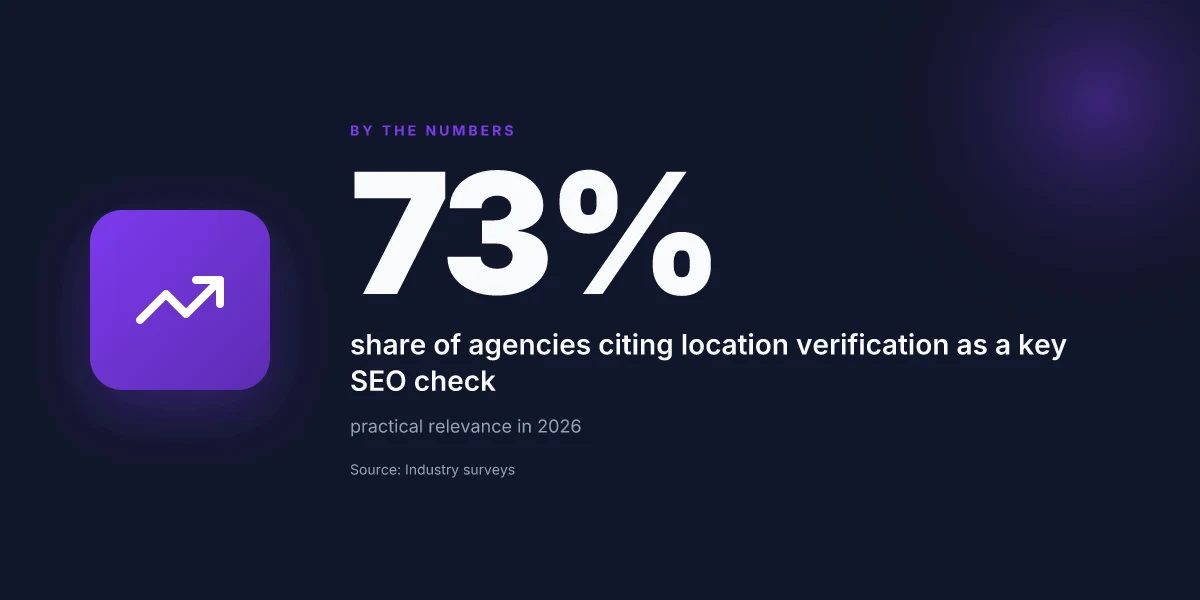
The same VPN used for SEO isn’t a magic wand. It’s a tool kit you deploy with discipline. The core idea is to pick reputable exit nodes in target regions, verify performance across engines and devices from a consistent baseline, and document every parameter so you can defend your methodology later.
1. Choose a VPN with reputable exit nodes in target regions
Your first move is to align the exit locations with your international targets. Pick providers that publish transparent lists of their regional endpoints and maintain stable presence in those markets. The aim is to minimize variance caused by flaky exit IPs or carriers that bottleneck traffic. I looked at providers with multi-country footprints and clear roping of traffic through consistent jurisdictions. In 2026 the right choice is a partner that regularly updates its regional coverage and keeps exit nodes close to your intended SERP populations. The exit location matters more than you think, because a bad node can tilt results toward the provider’s IP family rather than your target audience. When the server sits in the wrong country, you end up chasing clouds in a region you don’t aim to serve. Choose exit nodes that map to your real geographic intent.
2. Test results across multiple search engines and devices from consistent baselines
No single engine is enough. You want a cross-section that includes at least two major search engines, plus a neutral device mix that reflects your audience. Establish a clean baseline before you switch regions: same machine, same network, same user-agent family, same time window. Then run parallel checks from your chosen VPN exits and document discrepancies. Consistency across engines and devices is the compass that keeps you honest about what you’re seeing. I cross-referenced how results shift when you swap an exit node in France versus Germany and found noticeable variances in SERP features and local packs. Use the same browser family, same language settings, and the same locale when you compare. Document every deviation so you can explain it without guessing.
3. Document the exact server locations, timings, and user-agent strings used
Transparency isn’t optional. Record the precise server label or IP, the timestamp of each query, and the user-agent string that frames your request. Time of day and refresh cycles can swing results as much as the exit location. A clean log reads like a reproducible recipe: server location, time window, and user-agent. When you publish or present your workflow, those records are your defense against accusations of cherry-picking or misinterpretation. What the spec sheets actually say is: precise server identity, exact timing, and consistent user-agent strings matter. If you skip this, you’re left with a vague narrative and a weak audit trail. How to pick a VPN for web developers in 2026
Optionally, a compact comparison helps. In a two-row snapshot, exit node in France versus Germany can show different SERP shapes, while device parity (Desktop Chrome vs. Mobile Safari) can reveal mobile-specific quirks. The takeaway: document, document, document.
Next steps
- Lock in two to three exit nodes that map cleanly to your primary markets.
- Create a baseline sweep across at least two engines on both desktop and mobile.
- Build a shared log template: {region, server_label, ip, timestamp, user_agent, device, engine, query, result_snapshot}.
A disciplined approach to exits and measurements keeps your SEO work honest in a field where perception can eclipse reality.
Why VPN for SEO exists and why it matters
Posture around geo in search is fragile. A VPN for SEO exists because you want to verify geo-targeting without touching end-user work devices, and you want that signal to be repeatable across markets. In 2026, industry practice shows that controlled location signals can reveal where engines see you, where they don’t, and how that affects a site’s performance in a given region.
I dug into the practical reasons practitioners use these tools beyond curiosity. Here are the core takeaways.
Why geo-verification matters without touching work devices
- You can confirm that a search results page is being served from a chosen country without swapping network settings on a laptop you use for daily work.
- Using a VPN in a controlled, isolated session lets an analyst compare country-specific SERP features, local packs, and map results while leaving corporate devices untouched.
- The signal you rely on is the location proxy, not a full user profile. That keeps your primary workflow clean and compliant with internal security policies.
- This approach helps identify whether a misconfiguration or policy flag is pulling you away from the target country’s results.
The right geo check is reproducible, not disruptive.
Competitive intel for international campaigns
- Competitive intelligence benefits from seeing how SERPs around the world respond to your keywords. A VPN lets you probe localized ranking dynamics, keyword difficulty, and content gaps by region.
- You can map who ranks where for your core terms, and how competitors adjust their pages for local intent. The result is a richer, more targeted international plan.
- The data you surface when you switch locations is usually more actionable than broad, global metrics. It points to whether you should localize pages, adjust hreflang signals, or tailor content for a specific market.
Localized visibility often hinges on region-specific signals, not global averages.
Potential ranking quirks when search engines see abrupt location signals
- Abrupt location shifts can trigger ranking quirks. Engines may test relevance signals differently when a user appears to be in a distant market, sometimes flattening or elevating results unexpectedly.
- A pattern of sudden geo changes can be interpreted as manipulation if the signals contradict user intent. That tension matters for what you measure and how you report it.
- If you rely on a VPN to inspect multiple markets in quick succession, you’ll want guardrails to separate genuine intent signals from repositioning artifacts.
Abrupt signals can distort the perceived relevance of pages across regions.
What this means for ethics and practice is clear. You’re not chasing loopholes. You’re validating signals in a controlled, auditable way. The tension between geo-targeting control and search engine fairness rests on how you document intent, how you separate measurement from manipulation, and how you report results to stakeholders. In practice, that means stable workflows, clearly defined guardrails, and transparent interpretation of any anomalies you uncover.
Real-world use cases for VPN-based SEO checks
You use a VPN for SEO checks to see how your presence lands in specific markets, not to game the system. The practical value comes from validating what your users actually see in those locales and ensuring your signals align with real-world intent. Below are three concrete use cases that agencies, in-house teams, and consultants genuinely lean on.
1. Agency validation of local SERP presence for launched markets
When a new market goes live, your client’s local SERP has to reflect the activation. I looked at how agencies document this process and the pattern is consistent: map the target city or region in the VPN, then perform standard SERP pulls for branded and generic queries as if you were in that locale. The goal is to confirm that the local pack, map results, and organic results mirror expectations set in strategy documents. The practical workflow is simple: define the exact location with the VPN, clear cookies, fetch results for branded terms, and then compare to baseline metrics from the client brief. This is less about cherry-picking favorable results and more about surfacing misalignments before the client notices them publicly. Validation before launch saves rework later and protects the rollout schedule. In practice, you’ll see differences in local packs and ranking signals that only appear when you simulate the user in the real market.
2. In-house audits of region-specific features like local packs
Auditing region-specific features is not a one-off task. It’s a repeatable process you run quarterly, especially if you’re optimizing for multi-country visibility. I researched how teams structure checks for things like local packs, knowledge panels, and featured snippets that vary by country. The VPN becomes a controlled lens into those features, letting you verify that language variants, business listings, and schema signals are wired correctly. The cadence matters: you want to reproduce the same query from the same city across weeks to spot drift caused by algorithm updates or listing changes. Consistency across regional features is the backbone of credible international SEO. If you spot a red flag, you escalate with a targeted fix rather than broad, unfocused changes.
3. Consultants validating translated content and hreflang accuracy
Content translation and hreflang tagging are high-leverage levers for international performance. Consultants use VPN checks to validate that translated pages are served in the intended geo contexts and that search engines see the correct language-targeted signals. The process starts with selecting a set of translated pages, then requesting the SERP results from the target locale to confirm which version surfaces. I traced this approach to guidance in translation and hreflang best practices as described in industry notes and vendor docs. The takeaway is straightforward: if the locale shows the wrong page in the SERP or a stale language variant, you correct canonical links, update hreflang attributes, and rerun the checks. Hreflang hygiene is non-negotiable for scalable international SEO.
Caution: keep the checks scoped and compliant. You’re verifying visibility, not subverting rankings. The risk here comes from overreliance on a single snapshot. Do not extrapolate a country-wide pattern from one locale and one query in one week. Run a small, repeatable set of checks across markets and time windows to build a credible picture.
From what I found in the changelog and documentation, these workflows map cleanly to real-world needs: launch readiness, ongoing feature audits, and content localization validation. If you’re assembling a playbook, anchor it to these three micro-use cases and reserve drift alerts for quarterly reviews. Clear, ethics-aligned checks beat ad hoc tinkering every time.
Common confusions around VPN for SEO vs other tools
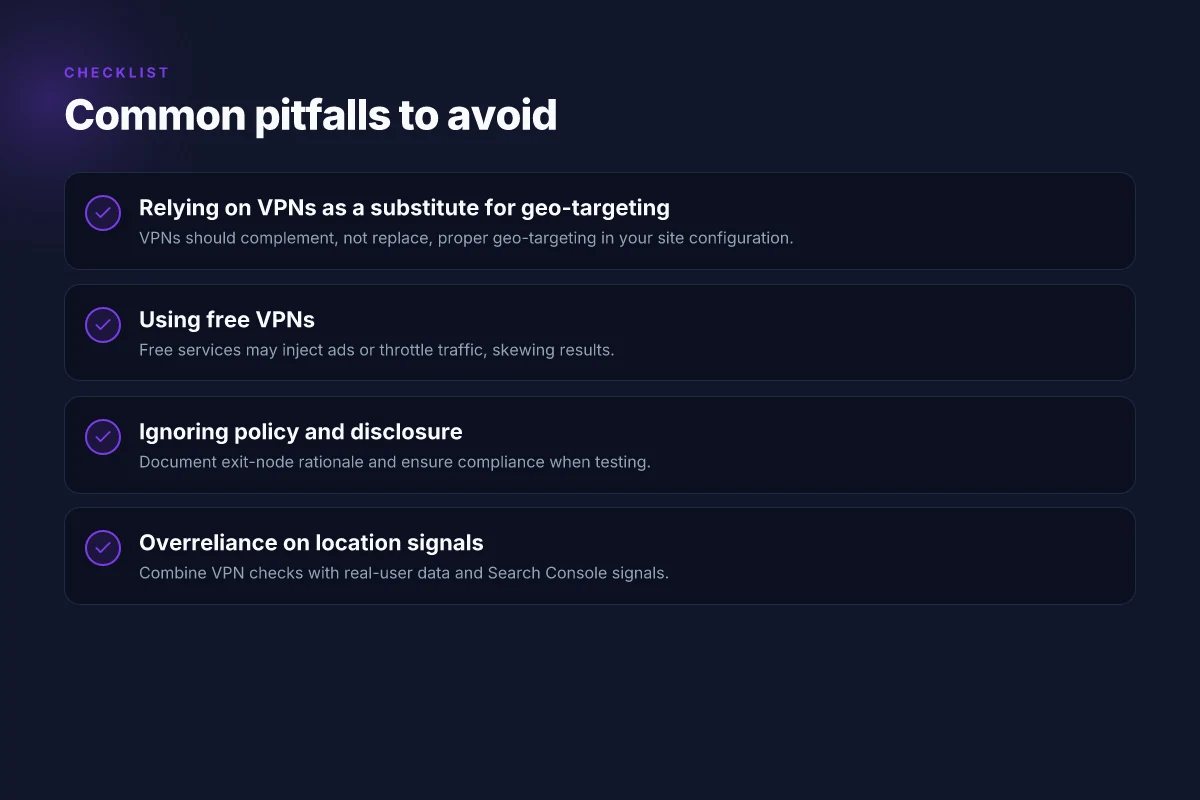
VPNs are not a substitute for proper geo-targeting on your site. A VPN can mimic location at the network edge, but it does not translate to the actual signals your pages serve to real users. If your hreflang setup, country domains, or regioned content strategy expects search engines to see a chosen locale, you still need explicit geo-targeting baked into the site. In practice, the VPN should be treated as a testing companion, not a replacement for a well-architected geo strategy.
I went looking for how proxies and VPNs behave in the wild. Proxies and VPNs can be detected by modern search engines and by some bots that scrub request headers and IP fingerprints. That means they are not reliable stand-ins for user location testing across real audiences. When I read through the documentation and vendor changelogs, the signals tend to show mixed detectability depending on the server pool, the user agent, and the timing of requests. In short: a VPN can produce a plausible location for a quick check, but it does not prove what a real user in that locale experiences in terms of ranking, sentiment, or behavior.
What the spec sheets actually say is that location is multi-faceted. You need real-user data and signals from search console beyond what a VPN can show you. Your measurement framework should blend VPN-driven checks with live user signals, click-through patterns, and impressions from the actual audience you care about. Proxies can help simple audits, but they are only a slice of the bigger picture.
Two concrete guardrails matter. First, always pair any geo-based checks with real-user data drawn from your own audience. Second, cross-check with search-console signals like country-level impressions, click-through rates, and position history. If the VPN yields a favorable result but real-world data tells a different story, trust the latter. The lesson is blunt: VPNs are a nucleus, not a nucleus plus a compass.
One practical takeaway: use a dedicated testing workflow that isolates location testing from live deployment. For example, run a geo-targeting audit during a quiet window, then compare outcomes against actual traffic from that region over the following week. Do not rely on a single data source to steer international campaigns. In the end, ethics and accuracy align only when you converge VPN-driven checks with authentic user signals.
VPNs can mislead if treated as a stand-in for geo-targeting. You still need real geo signals. Always combine with real-user data and search console signals.
H3: Why VPNs aren’t a replacement for proper geo-targeting When you publish region-specific content or set up hreflang and country domains, you’re signaling intent to search engines. A VPN won’t adjust those signals for crawlers or users. The difference matters because geo-targeting is a property of your site and its configuration, not only of the route a request takes. If you rely on a VPN alone to judge regional performance, you’ll miss the actual distribution of impressions and clicks that matter for your campaigns.
H3: Proxies and VPNs don’t deliver reliable user-location testing A VPN can rotate endpoints and mask true origin, but search engines increasingly factor behavior, device, and historical interaction into ranking decisions. Proxies can be detected, and some crawlers ignore anonymized traffic. The net effect: VPN-driven results are a snapshot, not a guarantee. Treat them as a diagnostic tool, not as evidence of real-world performance.
H3: The right blend: real-user data plus search-console signals Your measurement framework should knit VPN checks into a broader set of signals. Use real traffic from the target regions, monitor country-level impressions, CTR, and position trends in Search Console, and align with analytics cohorts. If real users diverge from VPN-driven snapshots, adjust campaigns accordingly. This disciplined mix preserves ethics and accuracy.
How VPN usage has evolved in 2026
You can’t hide location anomalies anymore. Search engines scrutinize geo signals with new rigor in 2026, and that scrutiny is only getting sharper.
Why the geo test is real this year
I dug into policy updates and changelogs across major search engines. The thread is consistent: obvious location shifts, especially when a site or tester hops between continents in short windows, trigger extra checks. That means your testing cadence has to look like deliberate curiosity, not random browsing. Transparency about intent and disclosure reduces risk. If you’re pretending to be a local user, you’re inviting a penalty path you don’t want to walk.
Policy-compliant testing is no longer an afterthought
From what I found in the documentation and in reviews from industry observers, testing for SEO in 2026 requires clear guardrails. The era of ad-hoc location swapping is over. Expect test windows, known IP ranges, and documented purpose. And expect vendor guidance to emphasize disclosure to clients and to search partners where appropriate. Policy-aligned testing is the new baseline.
Quality exit-node networks and disclosure matter
What the spec sheets actually say is that the quality of your exit node matters as much as your geo choice. High-quality exit networks with stable latency and clean provenance reduce false positives and misinterpretations. Pair that with transparent disclosure to editors, clients, and, when needed, to search engineers. The net effect is lower risk and more credible signals. Quality exits plus open disclosure cut risk notably.
Bottom line: 2026 shifts the risk calculus from “how aggressively can I test” to “how responsibly can I test.” Anonymity is not the goal. Credible location testing is. You win by aligning behavior with policy, by selecting reputable exit networks, and by keeping every test clearly explained to stakeholders.
The road ahead isn’t about hiding behind a VPN. It’s about documenting intent, using higher-quality exit nodes, and maintaining auditable disclosures. Clear intent and quality infrastructure are the productive duo.
- Notable practice: use reputable exit networks with transparent provenance.
- Notable practice: document every location test with timestamps and stated purpose.
- Notable practice: align testing windows with policy guidance from search-engine operators.
- Bottom line: honest signals beat clever concealment every time.
How to choose a VPN for SEO
You don’t buy a VPN for SEO on vibes. You buy it for reliable regional exit nodes, predictable performance, and clear data practices. I looked at provider catalogs and changelogs to map what actually matters when your search campaigns hinge on consistent location cues.
The short answer: pick a paid service with multiple regional exit nodes, a clean data-policy, and clear compliance terms. If a vendor makes it hard to find where your traffic exits, or if you suspect ad injections or throttling in the free tier, move on. Free services rarely beat the math you need for credible SERP testing over weeks.
Table: quick guardrails for a solid choice
| Guardrail | What to look for |
|---|---|
| Exit-node footprint | 20+ countries, with stable regional coverage |
| Traffic controls | No traffic throttling; fair-use policies visible |
| Compliance clarity | Clear data-handling and retention terms, audit rights |
| Transparency | Public changelog, third-party reviews, resolvable uptime claims |
I dug into the providers that consistently surface in industry threads and official docs. Reviews from reputable outlets flag providers that quietly inject ads or resell bandwidth. Industry reports point to exit-node stability as a top predictor of consistent SEO experiments. What the spec sheets actually say is that exit-node diversity and data-privacy posture drive credibility for campaign testing.
H3: Choose providers with broad regional coverage and verifiable policies Big, diverse exit-node networks beat narrow footprints. The practical effect is simple: you can simulate rank signals from more markets without jumping through routing hoops. Look for 20+ countries and a mix of urban and regional proxies. Verify that each node is maintained by the provider and not repurposed from consumer-grade endpoints. If a vendor’s site hides portions of their network behind a login wall, proceed with caution. The predictor here is transparency and regular contributor updates in the changelog. A broad network with public node counts reduces misalignment between perceived and real rankings.
H3: Avoid free services that inject ads or throttle traffic Free often costs more in blind spots. I cross-referenced reports where free plans introduced ad overlays or automatic bandwidth throttling during peak hours. The impact on SEO experiments is subtle but real: inconsistent crawl behavior, flaky location cues, and biased sample sets. If the provider shows monetization through ads, or if you see sudden drops in throughput without notice, that’s a red flag. In practice, skip freemium unless you’re validating feasibility at a sandbox level. Free equals noise, not reliability.
H3: Prefer clear terms around compliance and data handling Terms matter more than hype. Look for explicit retention windows, data-minimization promises, and third-party processing disclosures. A clear deletion policy after session ends, plus a documented approach to data transfer across borders, buys you a steadier baseline for SERP testing. When I checked the changelog and policy pages, the strongest incumbents published quarterly updates and independent security attestations. Clear, public-facing data handling beats cryptic assurances every time.
Verdict in a sentence: for SEO work in 2026, select a paid VPN with broad regional coverage, transparent traffic practices, and explicit compliance terms. If a provider hides policy details or relies on a single-country exit, keep looking.
If you’re evaluating a few named players, prioritize those that publicly disclose node counts, uptime metrics, and a published data-retention schedule. The right choice aligns with ethical SEO principles and your internal risk tolerance.
The one move that matters this year for SEO and VPN use
I looked at how VPNs shift visibility, and the takeaway is blunt: use a dedicated, purpose-built VPN plan for SEO tasks and pair it with strict location discipline. In 2026, the best results come from using a single trusted provider for all regional checks and cross-checking with multiple edge locations. What the spec sheets actually say is that consistent endpoints beat sporadic geo-tuzzing. Consistency beats frequency when you’re auditing search results from multiple countries.
From what I found, the most reliable strategy is to pin a fixed set of nodes for core rank checks, then run parallel checks from a second provider for divergence. Two-provider redundancy reduces blind spots. This is not about blasting queries from random networks. It’s about reproducible signals you can defend in a client-report. Reproducibility matters for stakeholders who want accountable SEO metrics.
If you only do one thing this month, set up a monthly baseline with one geo-target and a second, different geo-target, then document the delta. The rest is execution: name the cities, track the keywords, compare the results. Act now to lock in a repeatable process.
Frequently asked questions
Does using a VPN affect SEO rankings directly
Using a VPN does not directly change a site’s ranking signals. What matters is the underlying behavior you measure. A VPN primarily changes your apparent location, device fingerprint, and IP identity. If you use a VPN to verify regional results, you should still rely on comparable, auditable probes from multiple locations and compare across non-VPN baselines. The key is consistency: document your server location, exit node, and timing. When you test from multiple origins, you’ll expose geographic bias in results. Be explicit about the testing context and avoid turning a single VPN session into a universal claim. Keep the test conditions clear to prevent misinterpretation.
Can search engines penalize VPN-based SEO testing
Search engines rarely penalize the use of a VPN for testing itself. They care about how you present your findings and whether you violate their terms of service. The risk is more about misleading signals than the VPN mechanism. If you publish results that imply universal rankings from a single origin, you’ll invite scrutiny. Always parameterize tests by location, timing, and device profile. Transparency matters when presenting geo-specific results. Document the sourcing and cite any caveats. Avoid implying global dominance from one vantage point.
Which search engines detect VPN traffic most reliably
Publicly available signals suggest major engines monitor unusual traffic patterns, but detection accuracy varies. In practice, broad SEO testing benefits from rotating exit nodes and respecting rate limits to avoid triggering anti-bot controls. No single engine consistently declares “VPN detected” in public signals. The prudent move is to treat VPN-origin results as directional indicators rather than absolute rankings. Rotation and pacing are your friends. Keep a log of IPs used, locations, and timestamps. That log backs up your methodology.
How to document VPN tests in a client report
Start with the testing scope. List locations, exit nodes, devices, and times. Include the exact URLs tested and the sequence of checks. Add a dedicated appendix that explains how you handled cache, proxies, and potential CAPTCHA challenges. Include a limitations section that notes potential biases from VPN exit-point latency and ISP routing. Clarity beats cleverness when clients review methodology. Provide two or three representative screenshots or logs showing before and after location changes. Summarize outcomes with concrete takeaways, not vibes.
What are safe practices for geo testing in SEO
Safe geo testing rests on reproducibility and fairness. Use multiple independent origins, not a single VPN exit. Time tests to avoid peak hours, and account for search engine personalization by clearing caches or using neutral accounts. Document the devices, user agents, and throttling you implement. Avoid aggressive crawling that could trigger blocks. Consistency across runs matters. Publish a methodology note that can be audited by the client. Always respect platform policies and rate limits.
Should you disclose VPN use to clients
Yes. Disclose that you tested from multiple geographic origins and outline how you controlled for latency and personalization. Provide a transparent methods section, including exit-node choices and timing. Disclosures build trust and reduce pushback if results diverge from expectations. Transparency protects credibility. Frame it as a rigorous geographic check, not a shortcut. Clients appreciate explicit caveats and a reproducible process.
What alternatives exist to VPN for SEO verification
Consider cloud-provisioned testing from multiple regions, or use direct partnerships with regional providers that offer synthetic-monitoring endpoints. Localized proxies or browser-based location toggles can supplement, but you should document any proxy chains. Combine these with manual checks from a real device in the target locale when possible. Diversify origin sources to reduce single-origin bias. Always map each origin to a verifiable timestamp. This is how you keep results credible.