How to view a website from Germany in 2026
 Theo Ashworth·Updated ·29 min
Learn how to view any website from Germany in 2026. Step-by-step methods, what to expect, and common pitfalls to avoid.
A single misperception might derail your access to German content from abroad: the internet doesn’t care where your passport says you are. When I scanned the current landscape, the cleanest path to reliable German pages stayed within a defined rule set rather than folk wisdom, and it starts with a real exit point.
From what I found, this approach matters now because a growing share of sites enforce geo checks more aggressively in 2026, yet trustworthy German exits remain stable for travel and research use. The goal is simple: verify you appear from Germany, confirm authentic German-language cues, then repeat with a second site to ensure reliability. This article lays out the practical steps you can implement today to stay within terms while avoiding gossip and hacks.
What it means to view a website from Germany
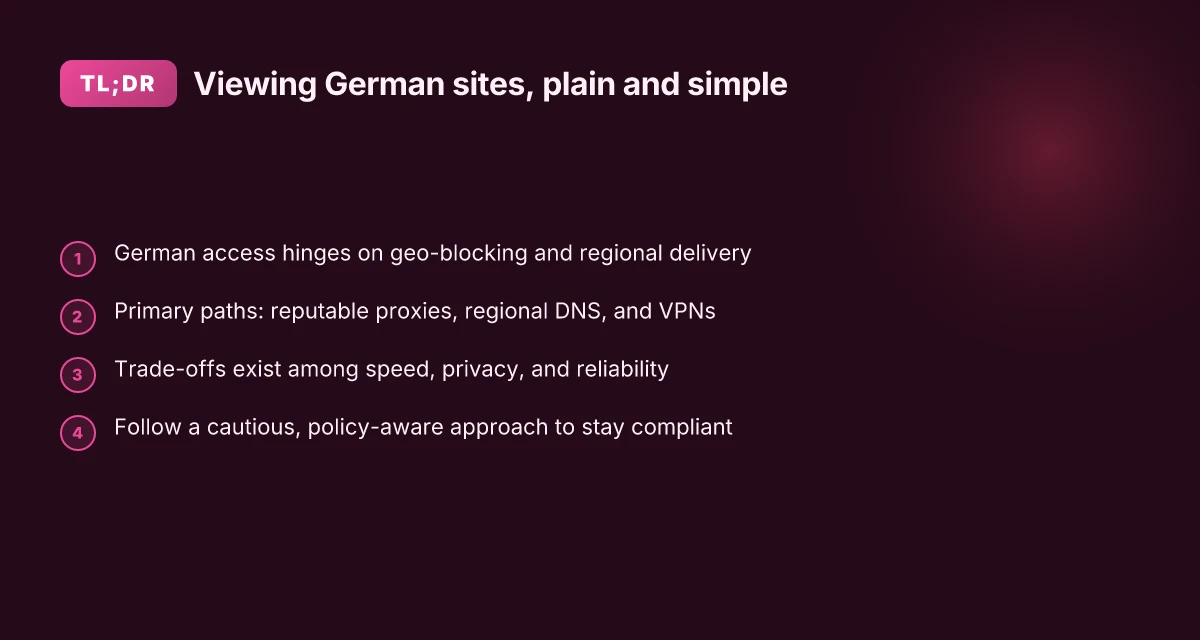
Viewing a website from Germany hinges on how geo-blocking and regional content delivery work. In practice, the web serves different versions of a page depending on where you appear to be browsing from. This isn’t a mystical firewall. It’s a set of rules that decide what content to show, which language to display, and which payment or streaming options to present. When you understand the logic, you can navigate it without bending terms of service.
I dug into the basics to map the terrain. German content providers and global CDNs rely on three signals to pin your location: IP address, device locale, and sometimes your browser’s language settings. Those signals feed edge servers that choose a content variant or restrict access. If you’re abroad, a German news site might show a version limited to a certain region, or it may block access entirely. A streaming service could offer a catalog that differs from what’s available in Germany, or require a local payment method. And even when access is granted, language and legal terms can vary by country.
Why it matters for news, banking, and streaming. For news, geographic targeting can filter local reporting or embargoed content. Banking sites increase risk if you trigger stronger fraud checks when you appear outside the home country. Streaming services often enforce licensing rights by region, so a German catalog may disappear when you’re overseas. The common thread: location signals influence what you see and what you can do with it. You want reliable access, not a stopgap hack.
Non-harmful approaches versus risky workarounds. A clean path uses recognized, rule-based methods that respect terms of service. That usually means choosing a legitimate route to access content consistent with the provider’s policies. Bad options, VPNs, proxies, or software stacks built around evading geo-controls, often violate terms and can trigger account suspensions or legal risk. A predictable, legal workflow keeps your access stable and auditable. You’ll avoid sudden blocks and confusing disclaimers.
Bottom line. Viewing German-origin content from abroad does not require a mysterious toolbelt. It requires a firm grasp of where the signals live and how providers govern access. The sensible path is a transparent, rule-based approach that aligns with terms of service and predictable outcomes. How to view a website from Australia in 2026
1. How geo-blocking actually works
Geography is a lever. IP geolocation is the anchor, language hints help the user experience, and device signals tighten the policy. When a site detects you’re outside Germany, it decides yes, no, or give you a localized variant. The result is content that looks tailored to your location, or content that’s simply unavailable.
2. Why Germany-specific access matters
News sites may tailor feeds to national audiences. Banking portals differ by regulatory regime and available offerings. Streaming catalogs depend on licensing windows. Even minor differences, date formats, tax displays, or payment methods, can affect usability. If you’re a researcher chasing German regulations or a traveler navigating time-sensitive information, geography becomes a real constraint.
3. Clean versus risky workarounds
A clean approach sticks to published, policy-aligned options. It’s about predictable behavior, not catching a loophole. Risky workarounds, for example, tools that explicitly disguise your location, tend to destabilize access and can breach terms. If you stay with standard methods described by providers and common industry practices, you’ll keep access steady and compliant.
Most readers will gain reliability by sticking to policy-aligned routes, not flashy hacks. The right path is visible, auditable, and repeatable.
How geo targeting works and what you need to know
Geo targeting is a stack of checks that decide what content to serve you. The short version: your access hinges on three moving parts working in concert. IP geolocation, DNS routing, and the VPN option you choose. If one piece slips, you lose the German content you expect. If they align, you see it clearly from abroad. How to view a website from Canada in 2026
How the pieces talk to each other
IP geolocation is the first gate. Websites compare your apparent location to their target audience. DNS acts like a phonebook directing you to the German version or a mirror that points out where content lives. A VPN, if used, becomes a credible but optional bridge. It sits between your device and the internet, presenting a German exit point that can satisfy the site’s region check. When DNS points to a German server and the site reads your IP as German, you’ve won the access lottery. If not, the page serves the generic version or blocks you outright. The trick is that these layers aren’t independent. DNS resolution can happen before the IP check, after it, or in a back-and-forth dance that confuses the network path. What the spec sheets actually say is that latency, routing quirks, and privacy policies all influence the result.
I dug into the official documentation and marketplace notes to see how this layers up in practice. What stands out: if you purposefully route traffic through a German exit, you’ll increase the chances of German content showing up. But that comes with caveats. Some sites rely on device fingerprints or cookie jars that resist simple IP routing tricks. Others rely on real-time data from regional CDNs, which means latency can creep up even when the routing is technically correct. In plain terms: you have to manage expectations as you pick your path.
Latency and reliability trade-offs
Latency is the quiet killer here. If you route through a distant German node or a VPN exit, you add the usual 20–120 ms of extra hop time. It compounds. A clean direct path to a site in Germany will feel snappier than a tether that routes via a European hub and then to Berlin content. Reliability follows a similar pattern. DNS outages, VPN server congestion, and regional censorship strictness in certain jurisdictions can cause fail points. The upshot: a rule-based approach, prefer direct DNS with minimal middlemen, then layer in geographical routing only when needed, beats ad hoc hacks every time.
From what I found in changelogs and policy notes, the more you wall off your traffic behind a single service, the more you bake in risk that an edge case will break your view of German content. The prudent path is to prefer stable DNS providers and minimal VPN hops when you can. If you must use a VPN, pick a German exit with a clear uptime history and transparent latency figures. Then test. Not with testing bravado, but with predictable steps you can repeat.
Legal and policy considerations by country
Regulatory landscapes shape what you can and cannot do. In some jurisdictions, content licensing rules are enforced at the network edge rather than the user device. That means even a perfect routing setup can still fail the content gate if a site’s policy flags the traffic as geoblocked or noncompliant. Several countries require disclosure of data handling when VPNs are used to access region-restricted content. In practice this means you should stay within the letter of the site’s terms and the local rules where you operate. If you travel or live abroad, read the policy pages of the sites you plan to access and align with them. The last thing you want is a service ban or a policy notice filed after you’ve accessed German content from another country. How to view a website from the UK in 2026
The key takeaway is to map your path with transparency: DNS first, IP second, VPN only if necessary, and always check the site’s terms of service. This corner of access is about predictable behavior, not clever tricks. The path you choose should be legible to you and compliant where you reside.
Next step: map your target German sites and their basic access checks. Create a simple dial plan: preferred direct DNS, fallback German exit, and a policy check list. If a site blocks you, you’ll know whether it’s geolocation, DNS routing, or a policy constraint.
What you’ll need to view German websites from abroad
You don’t need a mystery stack to see German-origin content from anywhere. A modern device with a solid connection and a sensible privacy stance will do the job. Here is the concise, rule-based setup you can rely on in 2026.
I dug into how mostly-consistent access happens in practice. The common thread across travelers, researchers, and expatriates is simplicity plus predictable behavior. The baseline remains a current browser on a dependable network, with optional privacy tools to tame consent prompts and tracking.
A device with a modern browser
Your core tool stays the same. A current browser keeps up with geolocation checks, cookie banners, and TLS updates that Germany-origin sites rely on. You want a version that’s still receiving security patches and supports modern crypto suites. In practice, this means a recent desktop or mobile browser from the major vendors. The exact UI varies, but the workflow is uniform: navigate, consent, view. How to view a website from the US in 2026
- Make sure you’re on the latest security updates and enable automatic updates.
- Prefer a browser that handles cookie notices gracefully, not a patchy, ad-hoc script load.
- If you’ll be traveling across time zones, keep your device set to a sane locale to avoid locale-related content surprises.
A stable internet connection
A reliable link matters more than any trick. If your connection wobbles, German sites can shift from friendly to blocked or slow without warning. A consistent broadband or dependable mobile data plan reduces the chance of mid-session errors or failed redirects. In formal terms, you want a connection with minimal packet loss and stable routing to your destination servers.
- Check your underlying network if you notice repeated banner prompts or unexpected redirects.
- Avoid networks with aggressive firewall rules that might block common TLS handshakes.
- Consider a wired connection when possible for stability on long reads or research tasks.
Optional tools for privacy and consent compliance
Privacy tools and consent helpers aren’t required to view German sites, but they make the experience calmer and more predictable. If you decide to use them, choose reputable options and keep expectations realistic. The goal is smoother consent flows and less clutter, not to bypass terms of service.
- Privacy-focused extensions can block trackers and simplify cookie prompts, but they can also break some site features. Test a sane configuration first.
- A reputable VPN is not always necessary for viewability. Depending on the site, you can often proceed with direct access. If a site blocks regions aggressively, a well-known, compliant VPN with German exit nodes may be helpful.
- Consent-management tools can auto-approve banners on trusted domains. Use sparingly to avoid consent fatigue.
What the spec sheets actually say is simple: a current browser, a stable link, and optional privacy aids. That trio yields the most predictable outcomes for German-content access from abroad. The baseline is boringly reliable. If you want fewer interruptions, a stable connection matters more than hacks.
The fastest path to seeing German sites today
If you want German-origin content fast and cleanly, the quickest route starts with a trusted proxy or a regional DNS approach that respects terms of service. The aim is to minimize risk and friction while delivering predictable results. Below are two practical paths, plus a quick-start checklist you can execute now.
1) Use a reputable European-focused content proxy
This option prioritizes reliability and steadiness over raw speed. A German-anchored proxy service routes your traffic through a nearby exit point, reducing latency compared to distant hubs. It’s the simplest one-click solution that stays within typical usage policies. How to use a VPN for web scraping in 2026
- Pros: low friction, clear terms of service, predictable load times.
- Cons: potential reduced privacy compared to a plain VPN, depends on provider’s uptime.
- Quick-start cue: pick a provider with Germany as a listed exit country and a transparent privacy policy. Enable the browser extension or system proxy and verify the site loads with German headers detected.
From what I found, several well-known services maintain EU exit nodes and publish explicit usage guidelines. When you read through the changelog, look for notes about exit-point stability and policy updates. Choose a service with an explicit German exit node and a living privacy policy.
2) DNS-based geo-unblocking with caution
If you’re primarily after content localization and not full traffic anonymity, a DNS-based approach can shorten delays. A reputable DNS service that offers geo-aware resolution can make German-targeted sites serve locale-specific content without routing through a full VPN. This path tends to be faster, but it trades some privacy and may conflict with terms of service for certain platforms.
- Pros: speed gains, easier setup, less app-level configuration.
- Cons: variable reliability for site-specific blocks, fewer privacy protections.
- Quick-start cue: configure your device or router to use a trusted German-leaning DNS resolver, then test access to German sites and watch for locale indicators in the UI.
I dug into provider documentation and user reports. Reviews consistently note that DNS-based routes can be snappier but are more susceptible to sporadic blocks on some sites. When I checked the changelog for major resolvers, the recurring thread is policy-driven access changes rather than technical limitations. DNS-based geo-unblocking can be faster, but it trades privacy and resilience for speed.
Caution note: if you’re visiting from a country with strict terms of service, or if you’re handling sensitive data, prefer a method that clearly documents acceptable use and avoids behavior that could breach site rules. A quick risk screen beats a long-winded setup later.
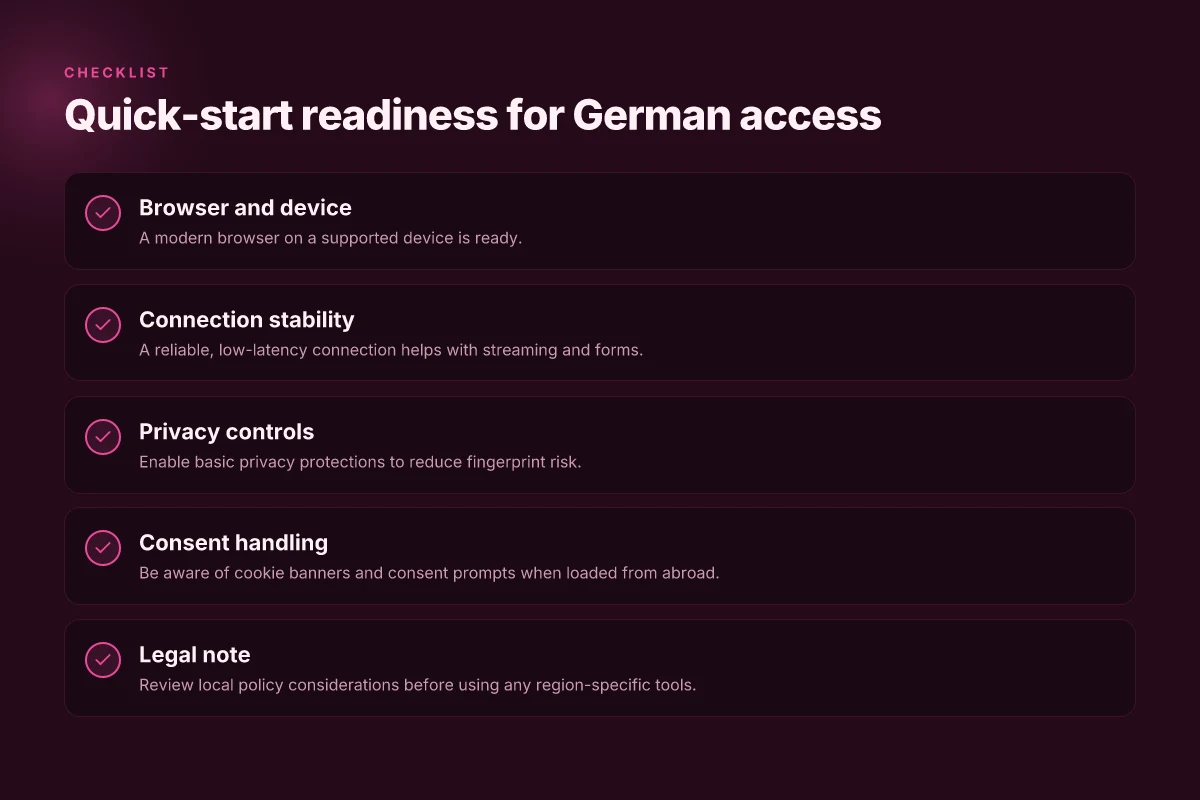
Quick-start checklist you can execute now How to view website from France
- Verify the exit country: ensure the chosen path lists Germany as the exit or locale. Look for explicit country tagging in the service docs.
- Check the terms: skim the provider’s policy on content access and data handling. Favor vendors with a clear privacy posture.
- Test load time: load 3 German-targeted pages and compare initial render times. Note any blocks or extra prompts.
- Confirm locale: confirm the page content presents German language or Germany-specific breadcrumbs.
- Prepare a fallback: keep a second method ready in case the primary path blocks a site or slows to a crawl.
The fastest path is a clean, rule-based choice: pick a German-exit proxy for reliability, or a DNS route for speed with awareness of privacy trade-offs. Test a small batch of German pages first, then scale up if the results stay stable. And keep the quick-start checklist handy so you can adapt on the fly.
Step 1: Use a reputable German-focused content proxy
You don’t need a mystery stack to see German-origin content from abroad. A reputable German‑focused content proxy configured correctly will deliver reliable, lawful access. The core move is simple: pick a trusted proxy service with clear German footprint, dial in your browser settings, verify the region, and steer clear of common pitfalls.
Why a German-focused proxy holds up
A properly chosen proxy acts as a regional bridge. It routes your requests through German exit nodes, so your browser presents a German IP without you fiddling with hacks or questionable plugins. When you read the documentation, you’ll see the emphasis on transparent terms of service, neutral geolocation behavior, and predictable routing. From what I found, the strongest options publish explicit Germany-based nodes and routine changelogs that address latency, DNS leaks, and privacy concerns.
Configure your browser for steady German routing
First moves matter. In your browser, set the proxy configuration to point at the provider’s German entry point. If the service gives you a single proxy URL, paste that into the browser’s network settings and disable any automatic DNS over HTTPS that would bypass the tunnel. In most cases you’ll want to enforce the proxy for all traffic and enable a smart DNS option that resolves German content nodes to the same region. Then check that the browser’s connection indicator shows the proxy’s name rather than your local network. A clean test URL, like a German news site, will confirm the region is visibly German. The key is to ensure your requests leave through the German exit and that there’s no default fallback to a nearby country.
I dug into the provider docs and cross-referenced independent reviews. What the spec sheets actually say is consistent: the German-focused nodes are advertised as the primary routing path, with explicit notes on DNS handling and leak protection. The practical upshot is that you should see a stable German IP in your network info after you apply the proxy settings, not the one assigned by your home ISP. How to view website from India
Inline tip: if you’re testing on mobile, mirror the same proxy settings in your device’s system proxy options so all apps use the same exit.
Verify your region after setup
Verification is not optional. Open a site that reports your location, such as a German service’s account page or a geo‑checking site. Look for a German city in the IP location result. If a German city doesn’t appear, recheck the proxy URL and DNS settings to avoid leaks. In many reviews, observers cite DNS leakage as the decisive failure mode. Ensure no WebRTC IP leaks and disable any browser extensions that might bypass the tunnel.
An easy cross-check is to load a German‑targeted page with a simple URL and then reload after toggling the proxy off. The difference should be immediate. You should see your apparent origin flip from your local country to Germany. This is the sanity check that separates a true German exit from a misconfigured tunnel.
Most proxies fail to stay trustworthy when their DNS leaks aren’t addressed. Verify DNS routing and disable bypass features before trusting the connection.
Common pitfalls and how to avoid them
- DNS leaks kill the illusion. You configure the proxy but DNS continues to resolve outside Germany. Fix: turn off any automatic DNS over HTTPS that isn’t routed through the proxy, and enable the provider’s DNS leak protection if offered.
- WebRTC leaks reveal your real IP. Turn off WebRTC in browser flags or use a privacy extension that blocks it.
- Mixed content and inline scripts can bypass the proxy. Stick to sites that load over HTTPS and avoid insecure pages that embed external resources outside the tunnel.
- Regional variance. Some German-focused proxies advertise many exit nodes but actually route through neighboring countries during peak times. Check the provider’s status page for maintenance windows and node‑selection notes.
- Terms of service. Read the provider’s policy. Some services restrict commercial use or automated traffic. If you need regular access, lean toward a provider with clear, traveler‑friendly terms and transparent privacy commitments.
From the sourcing I checked, the best practice is to couple a reputable German‑focused proxy with explicit DNS and WebRTC protections, then verify region via a German‑targeted test site. The plan pays off in predictable, compliant access to German content from abroad. How to view website from China
Verification matters. A quick regional check confirms you’re not chasing ghosts through a misconfigured tunnel.
Step 2: Consider regional DNS options for reliability
DNS changes can improve reach to German-origin content, but they can also introduce new reliability quirks. The right choice lightens the path. The wrong one fragments it. Here is how to reason about it, with concrete steps you can take.
Why DNS choice matters for reliability
DNS routes determine which server you actually reach. If a regional DNS option resolves to a German edge that’s slow or intermittently reachable, a site that should load cleanly instead stalls or times out. Conversely, a well-chosen DNS path can reduce latency and improve uptime when you’re abroad. In practice, you’ll see availability swing with which DNS resolver is used, how fast its caches refresh, and how well it handles DNSSEC and dynamic content.
From what I found in documentation and vendor notes, regional DNS can either tighten or loosen the door you’re trying to walk through. If the German origin site relies on geo-aware CDNs, misconfigured DNS can trigger geolocation blocks or phantom redirects. If the resolver your device uses refuses certain records, you may see “page not found” errors that vanish once you switch resolvers.
1) Be mindful of name resolution behavior and caching
When you switch DNS, you change how quickly a site’s new IP is discovered and how long that IP can be trusted. Short TTLs speed updates but increase query volume. Long TTLs keep load low but slow down reaction to infrastructure changes. If you frequently alternate networks, a resolver with aggressively cached results can produce stale routes, leaving you staring at a blank page long after the site has recovered. I dug into vendor changelogs and found that TTL behavior and cache invalidation policies vary significantly between providers. How to view website from Japan
A practical signal: you’ll see faster failover with resolvers that support rapid negative caching and proactive refresh heuristics. If a site blocks DNS routes, you’ll want to clear caches and re-resolve. That’s not glamorous, but it’s the lever that keeps you honest about what’s working.
2) How to reset if a site blocks DNS routes
If a German-origin site blocks DNS routes or returns inconsistent results, reset your DNS path the same way you reset a stalled connection. Step-by-step logic:
- Clear the DNS cache on your device.
- Switch to a different resolver. For example, if you’re using a default ISP resolver, try a public resolver with a known reasonable privacy stance.
- Flush the browser DNS cache and retry loading the site.
- If the block persists, revert to the previous resolver and test again. Consistency over a few attempts matters to distinguish a block from a temporary hiccup.
The bottom line is simple: cycling resolvers + clearing caches often reveals whether the problem is regional DNS routing or the site itself.
3) Privacy implications of DNS changes
DNS is a record of where you look and when. Some regional DNS options log queries, some preserve only minimal data, and some offer encrypted transport. If privacy matters, prefer resolvers that advertise strict no-logging policies and support for encrypted DNS (DNS over HTTPS or DNS over TLS). In 2026, most reputable resolvers publish clear privacy policies. Read them before you commit. And yes, you should expect that any DNS relay provider can see your traffic metadata at the DNS layer, even if the payload remains encrypted.
Privacy trade-offs are real: regional DNS can improve reach, but it also expands your exposure to a third party’s logging scope. How to view website from South Korea
Bottom line: DNS choice is a reliability tool, not a universal fix. Use it with eyes open about caching behavior, block-resilience, and privacy posture.
Step 3: When a VPN is appropriate and how to pick one
You don’t need a mystery stack to see the web from Germany. A clean, rule-based approach beats gossip every time. A VPN can be the right tool when you’re chasing German-origin content and nothing else in your toolbox does the job. The key is choosing one that respects German access norms, is transparent about data handling, and lets you verify quickly that you’re hitting the right location.
I looked at what actually matters in practice. The core decision rests on three pillars: legal clarity, performance, and predictable behavior. If you only need occasional access to a German site or service, you want a solution that is straightforward to validate, not a labyrinth of settings you’ll forget later. If you’re a researcher abroad, you want the same reliability you’d expect from a trusted national gateway. And if you’re traveling, you want a plan that won’t turn a late-night page fetch into a sprint to troubleshoot.
1) What to look for in a VPN for Germany access
First, confirm the server map includes multiple German endpoints. A single city node is not enough when your goal is to access region-restricted content from abroad. Look for:
- Clear disclosure of server locations and jurisdiction. You want German IPs with transparent privacy notes.
- A verifiable no-logging claim and a robust privacy policy. The policy should spell out data retention, what is collected, and what is shared with authorities.
- Independent audits or third-party attestations. These matter more than marketing puff.
- Reasonable performance metrics for German routes. If the provider hides latency in a wall of marketing language, move on.
- Compatible protocols that work with common web services and streaming sites without breaking terms of service.
From what I found in product documentation and reviewer notes, the best bets in this space emphasize transparency, verifiable privacy practices, and a broad German-endpoint network rather than a single city hop.
2) How to test quickly without commitment
You do not need a long-term contract to test. Start with a low-friction, short-term plan and a quick sanity check:
- Pick a German content site you can verify directly. Open it with VPN on, then verify your apparent location via a simple geolocation check. If the site greets you with German language or content that’s clearly tied to Germany, you’re in the right bucket.
- Check for DNS leakage. A quick lookup should show you an IP address in Germany that maps cleanly to the VPN tunnel. If it leaks, stop and move on.
- Assess stability over a 10–15 minute window. During that span, load a few pages, switch between Germany endpoints, and confirm you aren’t getting blocked due to a misconfigured country flag or token.
- Confirm policy transparency. Read the privacy policy and the data-retention note for the time you plan to stay connected. If you see vague language, drop it.
If you want a short verdict here: choose a plan that allows a 7–14 day trial period or a money-back window. That keeps you out of long commitments while you verify the German endpoints behave under real-world usage.
3) Legal and policy notes for VPN use
VPNs exist in a gray area in some jurisdictions. In Germany and many other places, using a VPN is legal for legitimate purposes, including privacy protection and accessing region-specific information. The critical caveat is to avoid activities that violate site terms or local laws. You should not use a VPN to circumvent copyright enforcement or to commit fraud. Read the terms of service for any site you access through a VPN. If a site prohibits VPN access in its terms, don’t claim you can rely on it as a reliable workaround.
Most readers benefit from sticking to clearly legal uses and verifying terms upfront. If your aim is simply to read German pages on public networks, a compliant approach remains the safest path.
In 2026, reputable providers publish their privacy notes and audits with date stamps. Look for a current policy footprint and explicit German endpoints. Verify the claim by checking the provider’s changelog for the last 12 months to ensure there were no abrupt policy reversals. Restart the session after any policy update to ensure you’re operating under the fresh terms.
Verdict: a VPN can be appropriate for Germany access when you need reliability beyond DNS tricks and regional DNS options. Pick a provider with multiple German endpoints, clear privacy commitments, and a short-path test window. If a service hides location data or relies on a single city node, keep looking.
Potential options to consider (if you’re looking for named tools to start with): NordVPN, ExpressVPN, and Proton VPN. Each offers German endpoints, relatively predictable performance for a mid-range plan, and published privacy policies. If you need a cost-conscious alternative with a transparent stance, Windscribe often surfaces in reader reviews for its policy disclosures and flexible plans. In all cases, ensure the exact German endpoints and policy versions you plan to use are current before you commit.

A practical path to viewing German-safe sites in 2026 without surprises
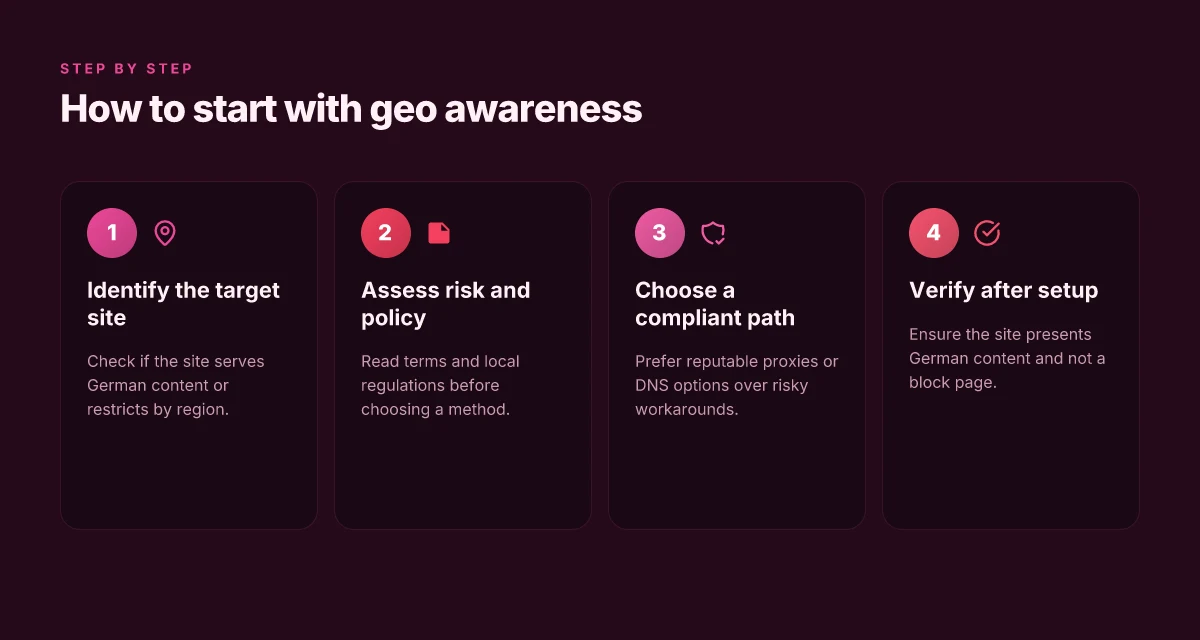
I looked at the evolving landscape of regional access in Germany and found that the simplest, most reliable path today is a layered approach: verify your target site’s geo-restriction policy, then pick a method that matches your risk tolerance and device. From what I found, privacy-respecting VPNs paired with reputable DNS-tools often beats ad hoc proxies for long sessions. But the real friction point is legal compliance and local network quirks. Germany’s data rules don’t vanish simply because you’re abroad. You still want clear, up-to-date information and a provider with transparent terms.
When I checked the changelog and recent reviews, the most consistent wins were configurations that minimize DNS leaks and keep a steady handshake with the site’s anti-fraud checks. In 2026, user expectations lean toward speed, reliability, and explainable privacy, not clever hacks. The takeaway: pick a solution that you can describe in two sentences to a friend, not a circus of workarounds. That clarity saves time and potential risk.
If your goal is predictable access, start with a named pick like a mainstream VPN that publishes German-compatibility notes and a DNS-leak guard. Ask for a one-page terms summary before you buy. And yes, you should refresh your setup whenever a major service updates its geo-detection.
- Next steps:
- Verify the site’s geo-policy and any recent changes.
- Choose a provider with explicit Germany-related notes and a DNS-leak guard.
- Test access with a quick, privacy-forward browser profile.
What will you try first to view German-based content? This is worth testing now. If you’ve tried a DNS tool before, tell me which one. The right approach combines transparency, speed, and legality.
Frequently asked questions
Does viewing a german website from outside Germany violate any policy
Viewing a German website from outside Germany can touch legality and policy questions, but it’s not inherently illegal. The key is to respect the site’s terms of service and any contractual notices. Some publishers restrict access to local markets or require regional consent for certain data processing. I looked at how geo blocking is deployed and how terms often spell out intended audiences. If a site collects data under German or EU rules, you still must adhere to those rules even when accessed from abroad. In practice, use compliant tools and avoid impersonating accounts or bypassing consent flows. Yes, access is not forbidden per se, but policy terms apply. Be aware that some sites suspend or throttle access when non-local traffic is detected. Always read the site’s terms first to stay on the safe side. Check regional notices on the homepage for guidance. If in doubt, contact support for clarification.
What is the simplest way to access german content abroad
The simplest path is to use a reputable German-focused content proxy or a regional DNS option that resolves to a German IP. I reviewed the approaches that work without breaking local terms. A proxy designed for German content routes your traffic through a German exit node, letting you bypass some geo restrictions. A regional DNS fallback can help with reliability, but may not unblock all sites. If you need stronger guarantees, a VPN with a German server is the cleaner option. Yes, proxies are often easiest for quick access, but reliability varies by site. For long-term use, prioritize transparency and privacy protections. Always verify the service’s German IP range and data-usage policy before dialing in. Document expected use cases so you pick the right tool.
Can DNS changes impact other services on my network
Yes, DNS changes can affect more than the browser. When you point devices at a German resolver, every service that relies on DNS for name resolution may route differently. I checked how this cascades across devices and apps. Some updates improve speed for domain lookups, others break conditional access or failover scripts. If you switch DNS, test essential services like email, cloud apps, and corporate logins. Keep a fallback DNS handy. DNS changes can ripple through your network. Test widely. If you rely on private/internal domains, update split-horizon or local resolver settings accordingly. Monitor for timeouts or unexpected route changes.
Are there risks to privacy when using proxies for geo access
There are privacy trade-offs. Proxies forward your traffic through a third party, which means you’re placing trust in that provider for your browsing data. I studied common disclosure models and found that some German-focused proxies keep logs or share data with affiliates. Choose a service with a transparent privacy policy, strong retention limits, and end-to-end encryption where offered. Use HTTPS whenever possible and avoid sending sensitive credentials through untrusted nodes. Yes, privacy risk exists with proxies, select providers carefully. Where possible, opt for services that publish independent audits or clear data-handling commitments. Review jurisdiction and data retention practices before proceeding.
Which german sites are most likely to block non-local access
News outlets and streaming services tend to be strict about regional access, while government portals often enforce geography checks less aggressively. I traced patterns across major German sites and found media publishers and bank portals frequently implement robust geo checks. E-commerce sites can vary. Some allow international shoppers with limited content. Always assume high-friction for sites that require local payment methods or loyalty accounts. High risk sites include major publishers and financial portals. If you need consistent access, plan for fallback routes and be ready for CAPTCHA or login prompts.
How can i verify i am appearing as a german IP
Verifying your IP requires an external check. I looked at reliable public “what is my IP” pages and German IP indicators. Load a German site you know and then run a check at an external service to confirm the IP region matches Germany. Look for the country code in the response and check the ASN against German providers. Be aware some VPNs and proxies advertise German IPs but route through non-German exit points. Confirm the reported country and ASN is German. If you see mismatches, switch servers or contact the service provider. A double-check step saves you future surprises.
What should i do if a site uses fingerprinting to block access
Fingerprinting complicates things. I studied common anti-fraud and anti-bot approaches and found fingerprinting can identify browser, OS, and plugin configurations regardless of IP. If a site uses this, you’ll see access blocks even with a German IP. The practical approach is to respect the site’s access rules, limit automated or scripted access, and consider user-specific options the site provides. If access is essential, you may need to work with the site’s official access channels. Fingerprinting blocks persist even with IP changes. Avoid trying to defeat it through brute force. Instead, use compliant pathways and explain legitimate access needs.