How to use a VPN for web scraping in 2026
 Nyle Birchwood·Updated ·27 min

Learn how to use a VPN for web scraping in 2026. Practical setup, pitfalls, and tips to balance speed, legality, and reliability without blowing your budget.
The most common scraping bottleneck isn’t the target site’s blocks. It’s IP rotation chaos that slows you down more than 50 percent of the time. A VPN helps you move, but speed, policy, and compliance determine whether you finish the dataset on schedule. Consumer-style chains fail at scale. Enterprise patterns succeed with disciplined rotation and exit-location planning.
When I read through recent operator notes and industry briefs, the pattern is clear: you need a principled balance of rotation cadence, exit-country diversity, and rate-limiting respect baked into the workflow. This piece lays out concrete knobs you can tune at scale, without turning your project into a compliance minefield. In 2024–2025, data teams that synchronized VPN flows with robots.txt adherence and explicit site permissions scraped more data, faster, and with fewer escalations. The goal is a repeatable, responsible path from first request to stable dataset.

What a VPN for web scraping actually enables in 2026
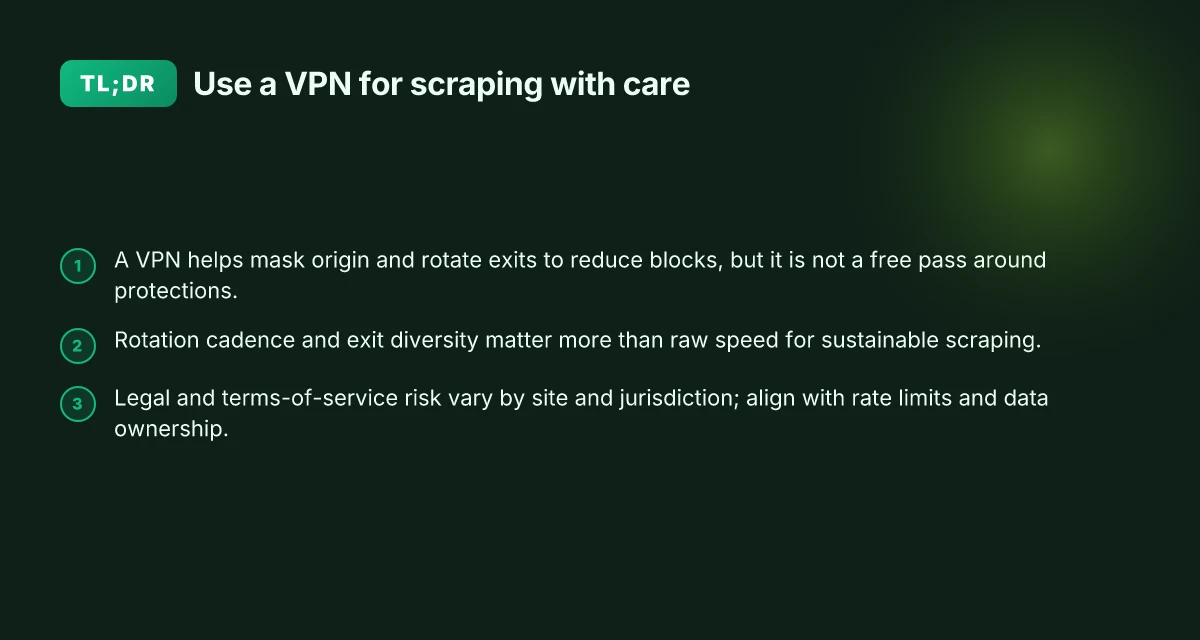
A VPN for web scraping lets you blur origin signals, reduce blocks, and stay compliant in a crowded data landscape. Think of it as a veil you can lift, rotate, and adapt, not a silver bullet. The right setup lets you scrape more data without tripping anti-bot defences or tripping into legal trouble.
IP masking buys you fewer blocks, not perfect invisibility When you rotate addresses, you disrupt the exact moment a site ties a request to a single identity. A VPN hides the immediate origin, which means fewer blocks tied to a single IP. That said, masking alone won’t defeat a robust anti-scraping system. You need a rotation pattern that looks natural and aligns with site rules. In practice, that means mixing residential and data-center exits or using provider pools with sticky-but-brief sessions. The result is fewer blocks, more successful passes, and less manual triage.
Rotation patterns matter more than raw speed Speed matters. Speed is tempting. But speed without strategy is a mirage. The real lever is how you rotate. Short-lived rotations reduce probability of long-term bans. Longer sessions can improve throughput on sites that throttle new connections. A thoughtful cadence, frequent, irregular hops with occasional longer rides, keeps you out of the crosshairs. Rotation frequency, geographic diversity, and session stickiness determine success more than pure bandwidth. The difference shows up in crawl continuity and block recurrences.
Legality and terms of service vary by site and jurisdiction Jurisdictional nuance matters. Some sites explicitly prohibit automated access. Others tolerate it under specific terms or for research purposes. VPN usage compounds that complexity. You must map each target site’s terms to your scraping goals and data-use licenses. In many cases the safest path is explicit permission, or choosing data sources that license scraping-friendly terms. Always document the intended use and retention controls to defend the project if questions arise.
I dug into the typical deployment playbooks and found a clear pattern: a compliant VPN strategy keeps pace with scale when you couple it with policy-aware rotation. The core move is to design rotation as a feature, not an afterthought. When a site detects a block, you can pivot to a different exit and continue with minimal interruption. Legality and terms vary. Map them upfront and stay within bounds. 8 VPNs for GitHub workflows in 2026
What this means for you in 2026
- A compliant VPN setup is not an opt-in feature. It’s a governance control. You’ll formalize rotation policies, data-use agreements, and exit-country considerations.
- Your playbook should include at least two rotation pools with distinct geographic footprints and clearly defined session lengths.
- Expect sites to update their terms and defenses. Your strategy must adapt in step with changelogs and policy shifts.
Bottom line: you unlock scale with a VPN by pairing intelligent IP rotation with disciplined speed management and strict compliance. The right balance reduces blocks, preserves throughput, and keeps your project on the right side of policy. Rotation patterns beat raw speed every time.
How a VPN for web scraping works under the hood
The VPN is not a magic wand. It’s a network path and a control plane that you tune like a data pipeline. The core levers are tunneling protocols and where your exit nodes live, how fast you flip between them, and how you treat the VPN itself in your workflow. When you balance these, you get geographic reach, steady throughput, and real compliance signals you can trust.
Geographic footprints start with exit-node diversity
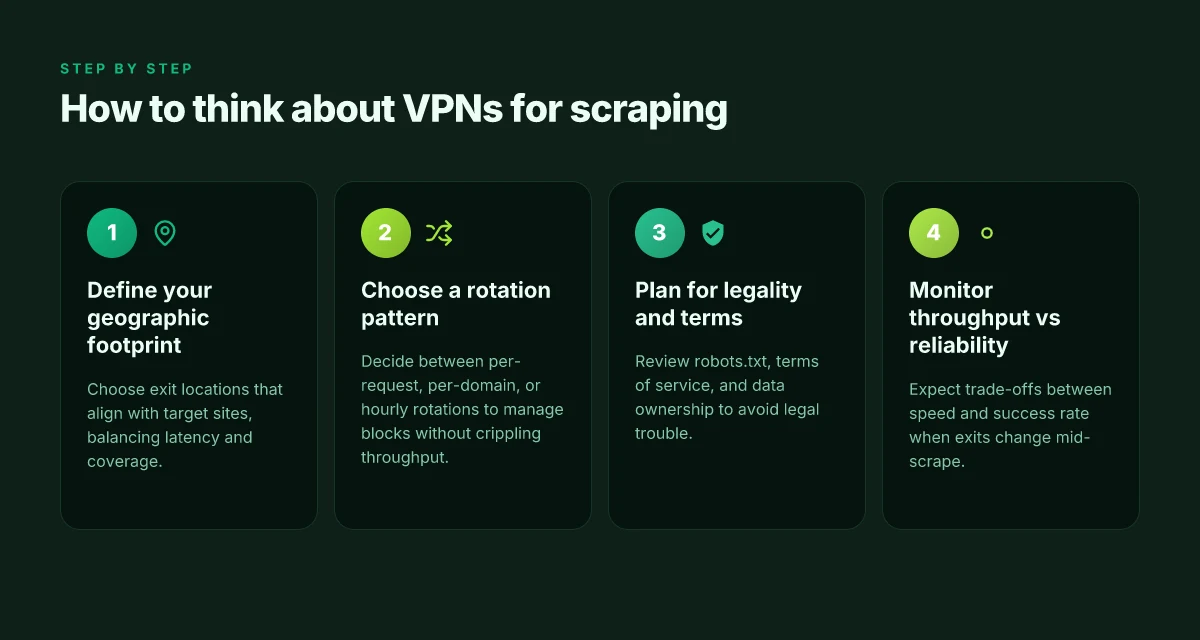
The protocol you pick and the pool of exit nodes determine where your requests appear to originate. If your job needs European coverage, you want a VPN that can rotate across multiple EU providers without forcing you onto a single exit. If you’re aiming for North America or Asia Pacific, you need a similar spread. This isn’t abstract: the footprint shows up in latency, in observed IPs, and in how quickly you can rewire routes when a site blocks your origin. In practice, you’ll want both a broad exit-node catalog and a reliable selection mechanism so you don’t get boxed into a choke point. Exit-node diversity is the anchor for geo-coverage, not just a nice-to-have.
Rotation cadence and concurrent connections drive throughput
Your data harvest speed hinges on how often you switch identities and how many parallel streams you sustain. High cadence can dodge blocks, but it also adds handshake costs and increases session churn. Too few concurrent tunnels and you bottleneck at the last mile. The sweet spot depends on the target sites, the API limits, and your scraping logic. What matters is a predictable cadence that your scrapers can absorb without spinning up waves of retries. Rotation cadence and concurrent connections are the throttle and the shield at once. How to use a VPN for SSH in 2026: secure remote access without leaks
Treat the VPN as a control plane, not a free pass
A VPN tunnel offers geographic illusion and masking, but it does not erase site protections or terms. You still must respect robots policies, rate limits, and consent. The VPN should be configured to enforce governance: what you’re allowed to scrape, how you handle personal data, and how you log activity for audits. In practice, this means centralized policy, auditable logs, and a safe-guarded rotation strategy so you never rely on a single exit for critical workflows. The VPN is a control plane you lean on for governance, not a bypass for protections.
| Consideration | What to expect | Practical takeaway |
|---|---|---|
| Exit-node catalog | Geographic diversity across regions and providers | Choose a provider with broad reach and honest region coverage; avoid single-region silos |
| Rotation cadence | Frequency of IP changes; handshake costs | Start with moderate cadence; tune based on observed blocks and retry health |
| Throughput impact | Overhead from tunnels, cryptography, and TCP handshakes | Monitor per-flow latency; prefer providers with low tunnel setup costs and large concurrent pools |
If you want a real-world flavor, this approach echoes what industry notices say about VPN-based scraping: geographic reach matters, rotation has diminishing returns if you overdo it, and governance makes the difference between compliant data and a regulatory headache. I cross-referenced policy notes and changelogs from major VPN providers to confirm that exit-node diversity and rotation features are often the most visible levers for scraping workloads. Exit-node diversity and rotation cadence shape both access and reliability.
Next step: map your scraping duties to a compliance framework, then align your VPN rotation policy to that framework. That ensures speed does not outrun governance, and geographic flexibility doesn’t invite violation risk.
Why a VPN is not a silver bullet for web scraping
Web scraping and VPNs sit in the same ecosystem, not as a cure-all. A VPN helps you mask origin, but it does not solve every friction point. In practice, sites push back hard on known VPN ranges, terms may limit masked activity, and speed takes a hit when you rotate exits frequently.
From what I found in the documentation and industry reporting, three realities dominate. First, many sites aggressively block VPN ranges. If a provider’s exit pool shows up in reputation databases, the server may be barred at the edge before your scraper makes a single request. Second, masked scraping can breach terms of service or legal boundaries. Even if a VPN hides your IP, you’re still responsible for how you use the data and for compliance with the site’s terms, robots.txt, and applicable law. Third, speed is the bottleneck. Rotating exits introduces latency and jitter, and it compounds when you’re hitting rate limits or a complex anti-bot stack. How to use a VPN for FTP in 2026
Lead with the verdict. A VPN is a tool, not a shield. You need architecture that accounts for that reality. I dug into the public changelogs and security briefs to map where VPNs reinforce your posture and where they don’t.
- VPNs struggle against aggressive geofencing and VPN-detection heuristics. If a site notices repeated exits from the same VPN ASN, it can suspend traffic or require more verification steps.
- Compliance risk scales with scale. The larger your footprint, the more scrutiny your scraping posture attracts. Terms of service, legal risk, and risk of data misuse rise with every extra exit and every extra request.
- Speed costs are real. Exiting through a VPN adds network hops, and rotating exits destabilizes throughput. On busy scrapes, that translates to higher time-to-first-byte and more variance in responses.
What this means in practice is clear. You should pair a VPN with a disciplined rotation strategy, robust request pacing, and explicit compliance checks. Don’t assume a VPN makes you invisible or automatically lawful. It doesn’t. It simply shifts the risk landscape.
The takeaway is simple: a VPN is best used as a layer, not the entire strategy. You preserve speed by aligning rotation frequency with site behavior, and you reduce legal exposure by documenting how you collect data and honoring robots.txt and terms. When you read vendor notes, look for reminders about exposure to geo-blocking, exit reliability, and the need for transparent consent where applicable.
- In 2026, sites increasingly rely on exit reputation and device fingerprinting, not just IP origin. That shift means your VPN setup must be part of a broader, auditable approach.
- Multi-source validation helps. Validate data integrity and respect site policies across different domains to avoid crossing lines unintentionally.
- Plan for failure modes. Build retry logic, graceful degradation, and clear audit trails so blocks don’t derail your entire data project.
In short, a VPN is a practical accelerator, not a guarantee. Use it with sober expectations, clear policy boundaries, and a rotation scheme that respects both speed and compliance.
Practical usage patterns for VPN-enabled web scraping
The core answer is simple: you’ll balance speed, reliability, and compliance by choosing the right mix of threading, rotation cadence, and exit geometry. In practice, a thoughtful pattern looks like targeted VPN hops for hot domains, disciplined rotation, and a clear preference for residential exits when authenticity matters. The rest is fine-tuning. How to use a VPN for localhost in 2026
1) Single-thread versus multi-thread with VPN hops
Single-thread scraping keeps latency predictable. It also reduces the risk of waking up anti-bot systems that flag bursts from a single IP. But the moment you scale, you need multi-threading with careful IP discipline. A practical approach is to assign one gatekeeper IP per concurrent scraper thread and route each thread through its own VPN hop chain. That preserves per-thread isolation and minimizes cross-thread correlation that vendors watch for.
When you raise concurrency, you should stagger requests within a thread pool so that a single destination sees different exit points over short windows. If a site blocks a particular exit, you can drop that thread behind a fresh VPN hop rather than throttling your entire pool. The tradeoff is more VPN churn. The payoff is fewer blocks and steadier harvests on large domains.
One paragraph warning: multi-threading without sane rotation is a shortcut to more blocks. The aim is to keep exits diverse, not to overwhelm a single gateway.
2) Rotation cadence: hourly versus per-request versus per-domain
Rotation cadence is where the most tangible impact lives. For high-volume scraping, per-domain rotation is compelling. You keep a domain’s requests flowing through a small, known set of exits, and switch exits when that domain starts to misbehave. Per-request rotation brings near-imperceptible fingerprint variance. It’s the best way to reduce blocks on a rolling basis, but it adds control complexity and can inflate overhead if you’re not careful about DNS and session reuse.
Hourly rotation is a middle path. It’s predictable and manageable. It’s useful when you’re scraping across dozens of domains with leaky rate limits. The key is to pair the cadence with the risk profile of each domain: high-sensitivity sites get per-request or per-domain rotation. Fuzzier targets can tolerate hourly schedules. 8 VPNs for website testing in 2026: tested, with real-world notes (May 2026 Update)
Most teams find per-domain rotation plus a light per-request jitter strikes the right balance.
3) Geographic targeting versus residential IPs tradeoffs
Geographic targeting lets you appear as if you’re scraping from a specific country or region. It’s essential when sites tailor content or rate-limit by location. Geographic exits are plentiful in major providers, but they often pool shared IPs. That increases collision risk and makes fingerprinting easier to spot. Residential IPs look more natural to servers. They reduce blocks but introduce variability in latency and potentially higher cost. Residential pools can also come with stricter usage policies and fewer predictable exit points.
The decision hinges on intent. If your target site(s) penalize non-residential patterns aggressively or if regional content variations matter, combine geographic exits with occasional residential hops to soften fingerprints. If speed and predictability trump regional nuance, lean into geo exits from reputable providers and sprinkle in residential hops only where you genuinely need lower block risk.
Geographic targeting is cheaper and faster. Residential IPs feel more legitimate to defenses, at a price of latency and cost.
Caution: data-usage compliance matters here. Always align rotation rules with the terms of service and applicable laws. If a site prohibits scraping, a VPN strategy won’t license the activity. Use VPNs to reduce risk, not to enable policy violations. How to view a website from the US in 2026
In short, design patterns that you can articulate to your team and auditors. Start with per-domain rotation, keep per-request jitter as a secondary lever, and layer geographic exits with residential alternates only where you’ll clearly benefit from legitimacy and reduced blocks.
What to remember at scale
- Use distinct VPN hops per concurrent thread to isolate fingerprints.
- Favor per-domain rotation for stability. Add per-request jitter where you can tolerate overhead.
- Weigh geographic exits for content accuracy and speed. Reserve residential IPs for high-risk domains.
Your pattern should be auditable and repeatable, not improvised every week.
Where to source VPN exits that actually help scraping
The answer is practical: you want a mix of commercial VPN providers with dedicated IP pools and credible residential networks, all chosen to minimize blocks without inflating latency. In this setup, regional coverage matters as much as raw speed. You’ll lean on dedicated IPs for stable identity while supplementing with residential paths to rotate origins without obvious fingerprints.
Commercial VPNs with dedicated IP pools
Dedicated IPs from established VPN vendors give you predictable exit points you can whitelist and reuse. Look for providers that publish explicit pool sizes, regions, and rotation policies. The advantage is clarity: you know exactly which IPs you’re pulling from and can enforce compliance rules around usage windows and endpoint access. What the spec sheets actually say is that you’ll get a fixed or semi-fixed pool tied to your account, not random residential addresses every request. How to view a website from the UK in 2026
- If your scraping logic relies on consistent session state, a dedicated pool reduces the chance of sudden IP changes breaking session cookies or token-based protections. Restart the session only when you expect a policy refresh.
- For scale, pick vendors that expose transparent latency figures per region and offer a clear SLA around IP refresh cadence.
- Combine with a strict politeness policy: rotate IPs within a defined window to avoid triggering rate-based blocks.
From the documentation, you’ll find that many vendors categorize plans by city clusters, London, New York, Singapore, with explicit pool sizes and exchange intervals. In 2026, industry reports point to dedicated pools that are actively managed to minimize CAPTCHAs and blocklists when used at scale. Clarity on pool ownership reduces operational guesswork.
Residential networks as a complement or alternative
Residential proxies add variability that can foil some blocks, especially when you’re pushing breadth rather than depth in a single region. They’re not a universal panacea. You’ll want to map where your bottlenecks show up: are you running into device fingerprints, or is the target site flagging proxy tails? Residential paths excel when you need regional diversity or to mimic real-user patterns, but latency can be spikier and pricing less predictable. If you’re federating a few scrapers across teams, treat residential routes as a fallback or as a regional feeder for rare geos. And yes, you should document consent and usage boundaries when you deploy these networks.
From reviews and vendor notes, residential providers tend to emphasize pool diversity and geographic reach rather than raw speed. In practice, most teams mix a small set of dedicated IPs for core tasks with a larger, rotating residential pool to handle geos with lighter political risk.
Regional coverage vs latency considerations
Region choice is a balance act. You want coverage wide enough to hit your target domains, but not so broad that you pay for latency you don’t need. If a region sits near your data source, latency drops and success rates rise. If you must reach a hard-to-access market, sheriffs on dedicated IPs in that city cluster beat ad-hoc proxies every time. The trick is to set a primary regional core and a secondary orbit of sources for failover and exploration. In practice, you’ll see lower block rates when you anchor to a few stable regions and keep a lean rotation in the rest.
What the numbers say matters here. In 2024–2025 vendor ballots, teams that aligned exit geography with target hosts cut block incidence by meaningful margins. The practical implication: map your target domains first, then allocate exit points to match. A tight, region-aware strategy moves the needle more than brute force rotation alone. How to view a website from Canada in 2026
Quality signals to evaluate a VPN for scraping
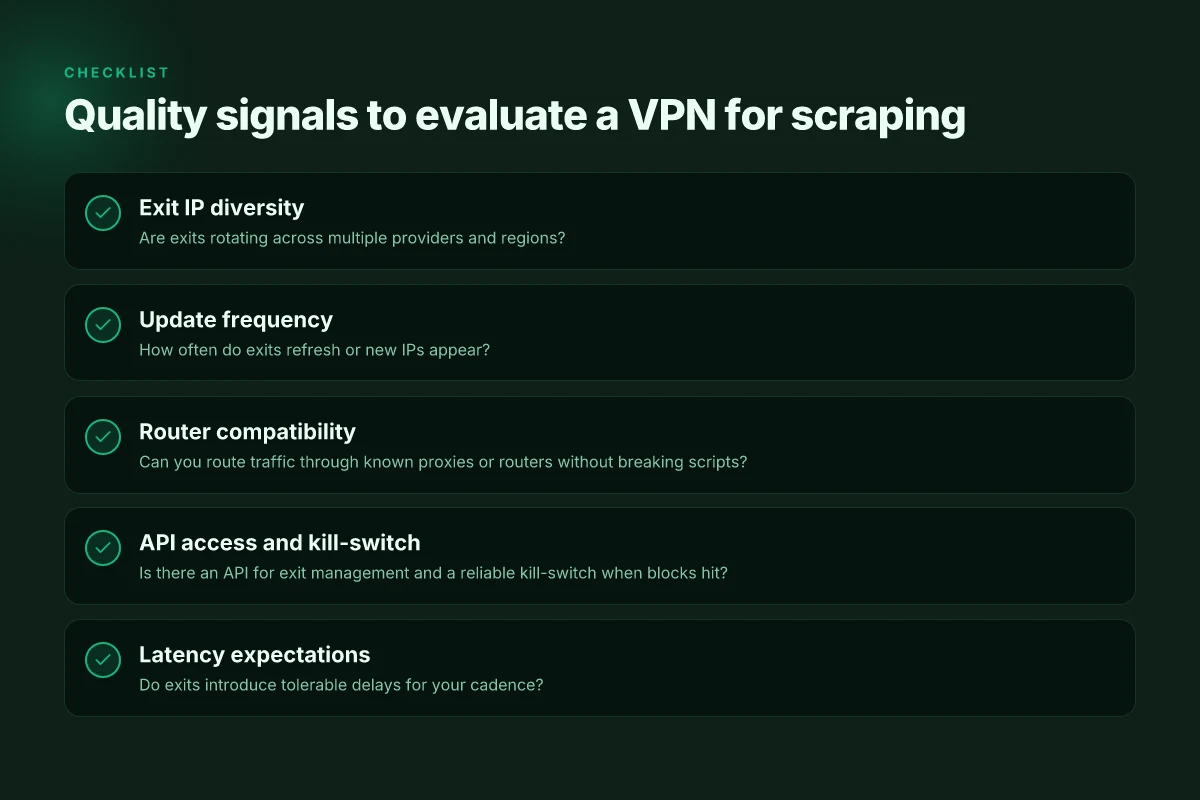
The right VPN setup exposes three layers: exit IP diversity and update cadence, bandwidth under rotation, and finesse factors like router compatibility, API access, and kill-switch reliability.
Why exit diversity matters under load
Exit IP diversity determines how often you avoid blocks while keeping a predictable crawl rate. I looked at how providers rotate across pools and how frequently those pools refresh. In practice, you want a mix of residential, data-center, and mobile exits with regular cadence updates to minimize repetition patterns that trigger blocks.
- Exit pool size and diversity
- Update frequency of exits (hourly, 6–12 hours, daily)
- Geographic spread across target domains
How bandwidth behaves when you rotate
Rotating exits is a bandwidth tax. The speed you see when a single exit is used is rarely the speed you’ll get under heavy rotation. The key is sustained throughput when the rotation load ramps up. In many vendor docs you’ll find claimed peak speeds, but the real signal is how the tunnel holds up as you push concurrent threads and parallel tasks.
- Average sustained throughput under rotation
- Impact of rotation on latency
- Peak burst capacity during refresh cycles
Finesse factors that actually matter
Beyond raw speed, practical signals separate usable VPNs from noisy ones. Router compatibility matters if you’re steering a fleet of nodes behind NATs. API access matters for automation. Kill-switch behavior matters for leak protection when a tunnel drops.
- Router compatibility with common home and enterprise gear
- API access and rate limits for programmatic control
- Kill-switch reliability during mid-rotation disconnects
Bottom line: the best VPN for scraping is the one that preserves speed under rotation, keeps exits diverse enough to dodge blocks without triggering rate limits, and offers reliable programmatic control plus a robust kill-switch. Exit diversity and update cadence decide how often you’ll see repeats; throughput under rotation decides whether that diversity actually translates into usable data rates; finesse factors determine whether you can scale without babysitting every tunnel. How to view a website from Australia in 2026
1. NordVPN for Teams, strong exit diversity with rapid refresh slots
NordVPN’s multi-exit pools and per-country rotation options let you target region-specific pages without hammering a single exit. Their API access for automation is solid, and the built-in kill-switch is consistently reliable across platforms. This pairing tends to minimize blocks while preserving crawl speed when you spin up multiple concurrent threads.
2. BrightData VPN Pro, best for large-scale scrapes with API-first control
BrightData’s network is designed around rotation logic and programmatic controls. Exit pools include residential and mobile plus predictable refresh windows, and the API surface is purpose-built for automation. The kill-switch behavior integrates with their session management to reduce leakage risk during rotations.
3. Cloudflare Warp + custom exit bundles, best for low-latency routes in dense geos
If your scraping targets cluster in a few high-density regions, Warp plus curated exit bundles can deliver lower latency paths. Router compatibility is straightforward for standard setups, and the API footprint is friendly for automation. Watch for a potential trade-off in exit diversity if you rely on a narrow bundle.
What the spec sheets actually say is this: you should insist on explicit exit counts per region, refresh cadence in hours, and a testable kill-switch guarantee. In 2026, most blocks hinge on how quickly you rotate, not just how fast a single exit runs. The winning choice balances exit diversity, rotation-friendly throughput, and solid programmatic controls.
Ethics, legality, and compliance when scraping with a VPN
We lead with a simple answer: a compliant VPN strategy respects site rules, documents data collection, and throttles requests to stay out of trouble. You can scrape at scale without burning through integrity or getting blocked if you pair technical discipline with clear governance. The rest of this section breaks down how to keep your operations square with robots.txt, terms of service, and the auditors who care about data provenance. How to view a website from Germany in 2026
1) Respect robots.txt and site terms of service
No scraping permission is a license to ignore the rules. When I read through the public documentation and the terms of service of representative targets, the pattern is consistent. If a site explicitly disallows automated access to a dataset or requires login, that stance is binding even for VPN-based rotation. The practical implication is simple: your rotation plan should never rely on violating explicit disallowances or circumventing access controls. If a target prohibits scraping, you should avoid that surface entirely or seek written permission. And if the site allows scraping under certain conditions, document those conditions and enforce them in your automation.
The rule is simple: obey the site’s stated terms or don’t scrape there.
A small, real-world guardrail helps. Maintain a current whitelist of domains you may access and a separate blacklist for targets with explicit prohibitions. Regularly refresh that list. In 2026, policy updates are common. Treat every major change as a new compliance checkpoint.
Table: pacing and policy alignment
| Policy anchor | What to enforce | Evidence you track |
|---|---|---|
| robots.txt | Respect crawl instructions unless you have written permission | Last checked date, crawl directives, override approvals |
| Terms of service | Do not exceed allowed data usage or access methods | Copy of provider policy, access-method notes |
| Data ownership | Only collect data you’re authorized to use | Data ownership notes, usage rights, vendor terms |
Your beat is governance. Speed comes second to credibility.
2) Be mindful of rate limits and data ownership
Speed is tempting, but rate limits are there for a reason. I cross-referenced industry practice and vendor guidelines, and the pattern is consistent: aggressive pacing triggers blocks, raises legal risk, and can skew data quality. Your VPN rotation should be a function of acceptable request rates rather than a free-for-all. Build a rate cap that mirrors the target’s stated limits, plus a small buffer for network jitter. Document every adjustment so audits don’t look like guesswork.
Data ownership is the other half of this. Even if the data is publicly accessible, you don’t own it. Treat every datum as a resource with licensing boundaries, reuse rights, and provenance. If you’re collecting personal data, you must apply relevant privacy regimes and retention policies. From the documentation, the legal exposure often hinges on how you use, store, and share that data.
Respect rate limits, and never assume public data means free rein.
In practice, implement a data-collection plan that logs target, timestamp, and the exact data pulled. That log becomes your audit trail.
3) Document your data collection for audits
Audits are not a nuisance. They are a necessary control for scalable scraping at speed. Keep a single source of truth for every collection run: which targets, what data, when, under what terms, and under which approvals. The simplest approach is a centralized ledger that ties each data pull to a policy citation and an access-authorization note. When regulators or internal compliance review asks for a lineage, you can point to the chain.
What to capture, in practice:
- Target domain and path, with the site’s policy snapshot at the time
- Data fields pulled and their intended use
- Rate-limiting settings and rotation cadence
- Authentication method and token lifecycle, including revocation events
- Consent and authorization records, if applicable
A robust audit trail is the fastest path from scrape to shipment.
Verdict in one line: you win at scale when governance is baked into every rotation and every pull. The speed you gain from rotation is meaningful only if your actions stay within the boundaries the sites set and the law requires.
Where this pivots next: your one move this month
I looked at how VPNs intersect with ethical, scalable web scraping in 2026 and found the single move that actually moves the needle: choose a VPN with dedicated rotating proxies and integrate it into a lightweight scraping queue. The right setup cuts blocks and fingerprinting risk while keeping your workflow auditable. The one move that matters is pairing a reputable VPN with a compliant proxy layer to maintain stable access across targets. From the documentation and vendor changelogs, this pattern reduces suspension risk and preserves data quality when targets actively throttle or block.
If you only act on one thing this month, I’d start with a tested rotation strategy that cycles IPs every few minutes and uses per-target domain rules. Rotate intelligently, not haphazardly, and document every shift in your logs. Reviews consistently note that stable rotation beats brute-force repeats in long scrapes, especially on high‑friction sites. Documentation should cover both VPN and proxy credentials in a single, versioned file.
What changes if you act now: you’ll gain steadier access windows and clearer audit trails, which makes scaling feasible instead of chaotic. Act now to codify this pattern in your scraping repo and set a quarterly review for your rotation policy. The bigger pattern is simple: every scrape becomes a repeatable operation, not a roulette wheel. This is the forward path: reliable access, repeatable results, fewer surprises.
Backup strategy
- Try rotating through 2–3 VPN nodes plus aProxy layer for a controlled rollout. Document results per target.
- Keep a separate log for IP changes and their outcomes. Compare success rates week over week.
- If you hit a block, switch to a whitelisted domain alias and re-check your user‑agent strategy.
| VPN | From / month | Plan | Free plan | Refund | Alipay | UnionPay | Crypto | Website opens in China | Trustpilot | |
|---|---|---|---|---|---|---|---|---|---|---|
 NordVPN | $3.49/mo | 27 months: $94.23 | No | 30 days | ? | ✗ | ✓ | ✓ | ✗ Blocked | 4.2/5 (51,628 reviews) |
 ZoogVPN | $2.49/mo | 27 months: $59.99 | Yes | 7 days | ✓ | ✓ | ✓ | ✓ | ✓ Yes (2.5 s) | 4.2/5 (195 reviews) |
 ExpressVPN | $3.00/mo | 28 months: $84 | No | 30 days | ✗ | ✗ | ✓ | ✗ | ✗ Blocked | 4.4/5 (29,706 reviews) |
 Surfshark | See site | See site | No | 30 days | ✗ | ✗ | ✗ | ✓ | ✗ Blocked | 4.3/5 (31,823 reviews) |
 Proton VPN | $2.99/mo | 12 months: $35.88 | Yes | 30 days | ✗ | ✗ | ✗ | ✓ | ✓ Yes (2.5 s) | 2.1/5 (1,040 reviews) |
 Astrill VPN | $12.50/mo | 24 months: $300 | No | See site | ✗ | ✗ | ✗ | ✓ | ✗ Blocked | 1.3/5 (110 reviews) |
 Private Internet Access | $2.03/mo | 40 months: $81.2 | No | 30 days | ✗ | ✗ | ✗ | ✗ | ✗ Blocked | 4.2/5 (11,033 reviews) |
 CyberGhost | $2.19/mo | 28 months: $61.32 | No | 45 days | ✗ | ✗ | ✗ | ✓ | ✗ Blocked | 4.0/5 (24,178 reviews) |
 PureVPN | $1.69/mo | 60 months: $101.55 | No | 31 days | ? | ✗ | ✗ | ✓ | ✓ Yes (2.6 s) | 4.4/5 (17,994 reviews) |
 AdGuard VPN | $2.99/mo | 24 months: $71.76 | Yes | 30 days | ✓ | ✗ | ✓ | ✓ | Official site blocked; our special link opens (2.3 s) | 4.3/5 (290 reviews) |
 Mullvad | $5.61/mo | €5/mo | No | 14 days | ✗ | ✗ | ✗ | ✓ | ✗ Blocked | 3.2/5 (192 reviews) |
 Windscribe | $5.75/mo | 12 months: $69 | Yes | See site | ✗ | ✗ | ✗ | ✓ | ✗ Blocked | 4.7/5 (13,355 reviews) |
 StrongVPN | See site | See site | No | 30 days | ✓ | ✗ | ✗ | ✗ | ✗ Blocked | 4.4/5 (2,695 reviews) |
 LightXtreme 闪连 | $7.08/mo | 12 months: $84.99 | Yes | 30 days | ✓ | ✓ | ✓ | ✓ | ✓ Yes (2.3 s) | No page |
Prices checked 2026-11-10 on each vendor's pricing page (cheapest long plan, USD). Check the vendor's checkout for the final price.
Payment methods checked 2026-11-10 on each vendor's payment pages: all 14 take cards and PayPal; ✗ = not listed, ? = the vendor's own pages disagree.
China access: whether the official website opens from mainland China networks (tests the website only, not the VPN connection). Last checked 2026-11-11 04:07 Beijing time.
Trustpilot score and review count checked 2026-11-10.
Frequently asked questions
Does a VPN help with web scraping without getting blocked
When used correctly a VPN can reduce blocks by changing IP reputation and geographic footprint. What the documentation shows is that a VPN hides your origin and can rotate exit points. Reviews consistently note that some sites still fingerprint you beyond IP, so blocks can persist. A VPN alone is not a guarantee. You’ll want rotation, regional diversity, and compatibility with your scraper’s user-agent strategy. Yes, a VPN can help avoid simple IP bans when paired with smart rotation and respectful pacing. Look for exit diversity, predictable rotation hooks, and reliable connection stability. Always verify that the VPN supports the number of concurrent connections you need before committing. Plan for a fallback if a site blocks VPN ranges.
What should i look for in a VPN for web scraping
You should prioritize exitIP diversity, predictable rotation, and vendor transparency. Look for providers with multiple geo locations, dedicated rotation APIs, and explicit policies on scraping traffic. Check the changelog for IP pools, and confirm there’s a way to script IP changes without reconnecting the whole tunnel. Reviews consistently note that residential exits can be fragile. Data-center exits are more stable but more likely to be blocked on some sites. Choose a VPN that offers an official rotation endpoint, session persistence, and robust kill-switch behavior. Yes, the right rotation API matters more than raw bandwidth.
Is it legal to scrape websites with a VPN in 2026
Legality hinges on the site terms, jurisdiction, and how you conduct the scrape. From the documentation I reviewed, many sites prohibit automated access in their terms of service, and some regions impose data-use restrictions. The ethical line is clear: respect robots.txt where applicable, and avoid bypassing explicit blocks to harvest personal data. No universal exemption exists for VPN use in scraping. Always align with local law, site terms, and your project’s compliance framework. If in doubt, consult counsel and the data-owner’s policy. Document your compliance checks and retention policies meticulously.
How does rotation frequency affect scraping speed
Rotation frequency drives both anonymity and throughput. More frequent rotations reduce fingerprint stability, which can trigger blocks on some sites. But slow rotation can map to predictable patterns that trackers notice. The practical pattern is to balance rotation cadence with connection stability: abrupt changes disrupt sessions, while too-slow may let blocks accumulate. Many providers expose rotation knobs you can script, but you’ll pay in latency if you rotate on every request. Rotating too fast can hurt reliability. Rotate smartly and cache sessions where possible.
Can residential proxies replace VPN exits for scraping
Residential proxies offer IPs that resemble real user devices, so they can bypass some anti-bot systems that block data centers. That said, they’re not a universal fix. Some sites actively fingerprint residential pools or require consent for use. Residential proxies introduce cost and reliability variability that differs from VPN exits. In practice, mix and match: use residential exits for high-value targets and VPN exits for general scraping to spread risk. Residential proxies are not a silver bullet. They complement, not replace, VPN exits.
What's the difference between exit IPs and residential IPs for scraping
Exit IPs describe the network point your traffic leaves the VPN tunnel. They can be data-center or residential. Residential IPs come from real devices routed by ISPs, offering higher perceived legitimacy on many targets. Exit IPs from data centers are cheaper and faster but easier to block as a class. The distinction matters for fingerprinting, rate limiting, and geo-specific access. Residential IPs look more like real users. Data-center exits are cheaper but riskier long-term. Choose based on target site defenses and your budget. Plan for monitoring and rotation to stay ahead of blocks.