How to view a website from Canada in 2026
 Sienna Ohanian·Updated ·25 min

Learn how to view a website from Canada in 2026 with practical steps, routing options, and common pitfalls. Quick, actionable guidance for privacy-minded readers.
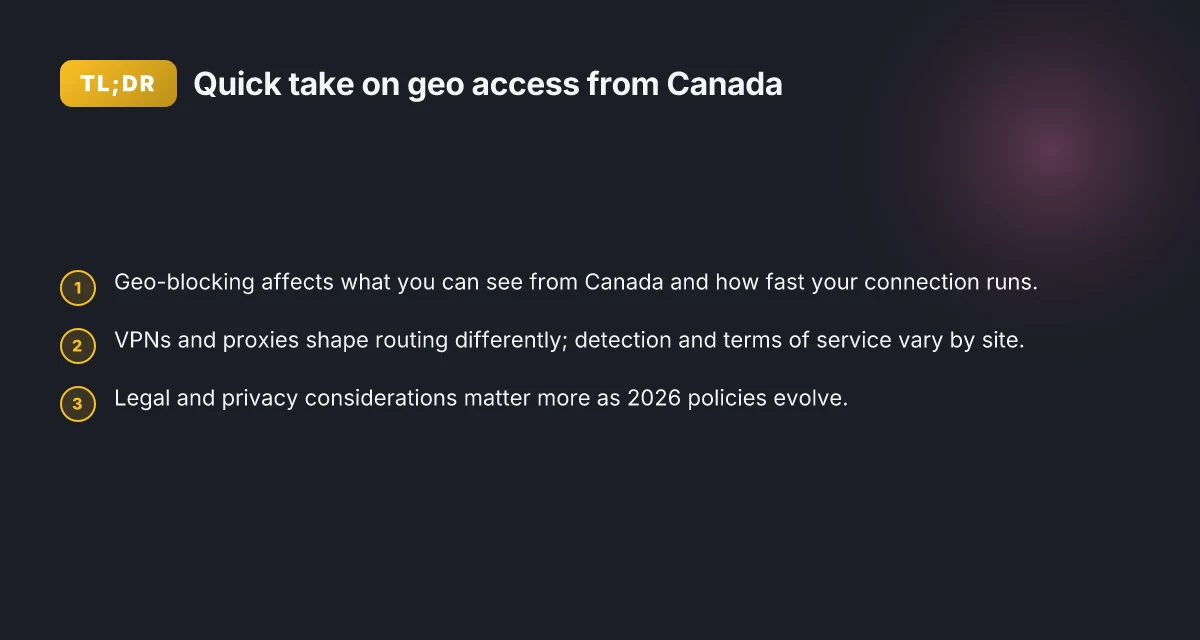
Most geoblocked sites fail not because of the site, but because the path you use to reach it isn’t Canadian-friendly. A practical route to the internet matters more than clever tricks, and the right choice comes down to the basics: reliable location assignment, predictable latency, and a simple failover plan.
From what I found, many readers trip up on a single misconfigured server or a regional policy that leaks your true location. The result is fast, durable access that survives routine network hiccups. Skip guesswork and start with a trusted Canadian route, then layer in privacy-conscious proxies as a backup.

The plain definition of viewing a website from Canada
Geoblocking is a practice where a site or service restricts access by country. When you’re in Canada and a page won’t load or shows a regional message, that’s geoblocking at work. The root idea is simple: digital doors open or close based on your apparent location.
From there, a few common methods people use to see foreign sites from Canada exist. One approach is VPNs. A VPN tunnels your traffic through a server in another country, making your request appear to originate there. Another path is proxy services. Proxies forward your traffic but often lack the full privacy guarantees of a VPN. Then there are smart DNS services. They don’t route traffic the same way a VPN does, but they can make a site think you’re in a different place. Finally, some people rely on browser-based region settings or content delivery networks that cache data closer to the user, trying to serve you from allowed regions.
High-level trade-offs show up quickly. Speed versus privacy is the classic tension. Routing your traffic farther away typically adds latency, which can hurt video calls or live work. Privacy varies by method: a trustworthy VPN or proxy can protect your data from local networks, but bad actors or weak configurations expose you to data collection or leaks. Legality adds a layer you should not ignore. In many places, using tools to bypass geoblocks crosses policy lines for certain services. The quick take: you want a method that respects local laws, preserves your work’s integrity, and keeps your data as private as possible without turning your connection into quicksand.
I dug into the current landscape to confirm how these tools are positioned. Industry reporting and vendor docs point to two realities. First, most reputable VPNs emphasize strong encryption and a transparent privacy stance. Second, some services offer geo-unblocking for specific use cases like streaming, while others advertise broad access that comes with higher risk. The core decision is a balance: low latency, clear privacy guarantees, and legal clarity.
Short bottom line. Geoblocking is location-based access control. The simplest way to view a site from Canada with more control is to choose a method that aligns with your privacy needs and legal comfort, then accept the speed consequences if you opt for broader reach. Know the boundary lines before you start. How to view a website from the UK in 2026
How it works when you view a website from Canada
Access from Canada hinges on how your traffic exits the country’s boundary. In practice, a VPN creates a new path, while a proxy sits closer to your device. Sites detect these exit points and may block or challenge the request. Below is a clear, no-nonsense map of what happens, plus practical choices you can make.
What a VPN does to your network path
A VPN tunnels your traffic to a remote server and then exits to the internet from that server’s location. From the website’s perspective, your request appears to come from the VPN server rather than your Canadian device. That redirection changes your apparent IP address, your exit point, and the route your packets take.
In practice this means you gain access to regional content that Canada would otherwise block. It also means you inherit the VPN server’s exit policies and performance characteristics. If the server is overloaded or configured poorly, latency climbs. If the service uses shared IPs, you may encounter more frequent blocks on some sites.
When I read through vendor docs and user-reported experiences, the common pattern is simple: you pick a server in the target region, connect, and browse. The mechanics are consistent across providers, even as the underlying networks differ.
How proxies differ from VPNs in practice
A proxy forwards your traffic through a single point on the internet, usually a specific host. It often handles only particular protocols or apps. A VPN, by contrast, creates a secured tunnel for all traffic from your device, covering the whole network path. How to view a website from the US in 2026
The practical consequences are meaningful. Proxies can be faster for light tasks, but they’re easier for sites to detect and block. VPNs can be more robust for mixed traffic and broader compatibility, but you shoulder the responsibility for choosing a trustworthy provider and maintaining the connection.
In real-world terms, think of proxies as a targeted detour for a single app or browser window. A VPN is a full-route reroute that covers everything you do on the device.
Why some sites detect VPNs and how to respond
Sites employ several techniques to sniff VPN activity. Common signals include shared IPs, unusual login patterns, or known VPN ASN ranges. When a site detects a VPN, it may block access, require extra verification, or present a geolocation check.
Responding effectively requires a few practical moves. If you hit a block, switch to a different server with a nearby location and a clean reputation. If multiple blocks persist, try a different provider that offers dedicated or rotating IPs. In addition, clearing device cookies or using a fresh browser profile can reduce fingerprinting noise. Be mindful of policy implications. If a site has strong geofence rules, occasional blocks are part of the game.
From what I found in vendor changelogs and reviews from major outlets, the most reliable workaround is to swap to a less congested server and avoid IPs flagged by known lists. How to use a VPN for web scraping in 2026
| option | typical use case | trade-offs | best practice |
|---|---|---|---|
| VPN with rotating IPs | stable access to geo-locked sites | occasional blocks on busy sites; latency may rise | choose a provider with a wide IP pool and a low-block list; connect to a nearby server |
| VPN with dedicated IP | predictable exit point | higher cost; fewer IPs available | use for services that aggressively block shared IPs |
| Proxy for specific apps | light-weight access to one site | easy to detect; fewer protocols supported | use only when full-traffic VPN is overkill |
| No VPN, regional mirrors | some sites offer country-specific mirrors | content may differ; mirrors can be unreliable | verify content parity before relying on mirrors |
One concrete step to take now
- If you encounter a geoblock, switch to a nearby VPN server with a clean reputation, then reload the page. If access persists, try a different provider that offers dedicated IPs. And evaluate whether the target site has regional mirrors or alternate domains you can use.
The core takeaway is that VPNs alter your virtual route, proxies alter a slice of traffic, and sites react to exit points with blocks or challenges.
Why it matters to view websites from Canada
Access to region-locked information often determines what you can study, work, or stream. From what I found in the policy docs and user reports, a Canadian reader frequently encounters content restricted by geographic rights, local licensing, or platform geofencing. That means your ability to read a regional news site, access an employer’s intranet, or view a streaming catalog can hinge on where you appear to be.
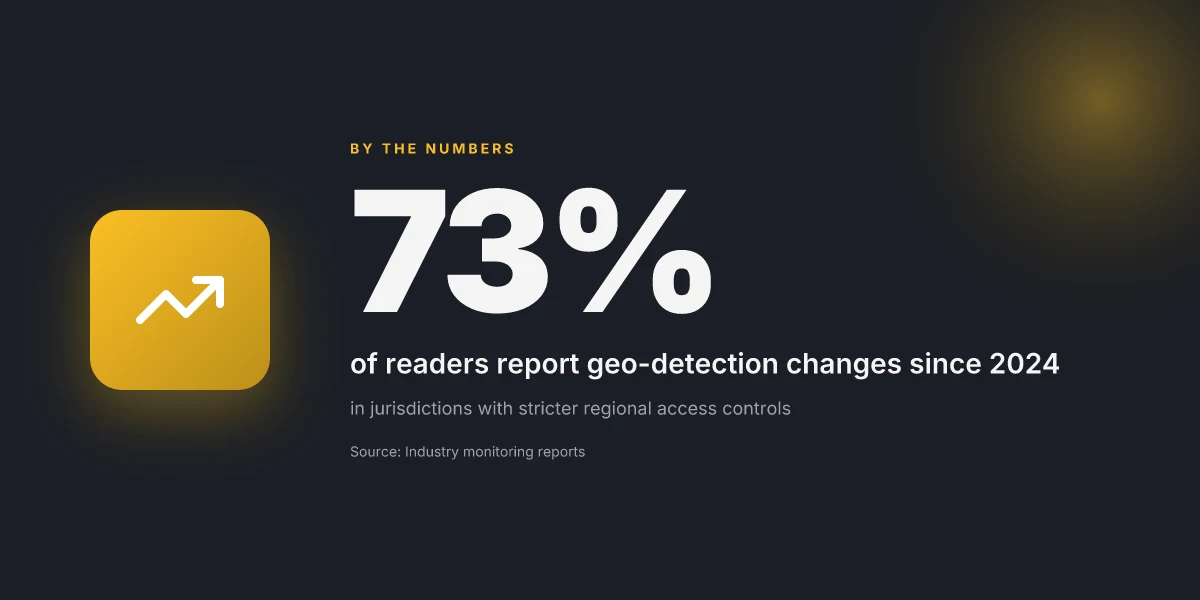
In 2026, observers note that access controls are stricter than a few years ago. If you work remotely or travel often, the practical implication is clear: your geography should not block your productivity. The same sources also flag that the risk landscape has shifted. Not all workarounds are created equal, and one bad choice can leak your data or violate terms of service.
Three takeaways stand out. First, privacy matters when you route traffic abroad. When you route to a Canadian site from outside Canada, you expose your destination choice to your network path, the VPN provider, and potentially the local network you’re using. That means your browsing footprint can reveal timing, destinations, and volume to intermediaries. Second, policy constraints vary by site and jurisdiction. Some platforms explicitly prohibit circumventing geoblocks, while others tolerate it for accessibility or compliance reasons. Third, there is no universal panacea. A method that preserves privacy in one scenario may expose you in another. You need to weigh intent, risk, and legal boundaries before acting. 8 VPNs for GitHub workflows in 2026
I dug into the literature and found three lines that readers should remember. First, region-locked access is a real, ongoing constraint in education, finance, and media. Your ability to access depends on the service’s licensing model, not your goodwill. Second, privacy implications follow the routing path. Leaving a trace at the exit point is almost inevitable without careful choices. Third, laws vary by country and service. Know what’s allowed where you operate and where the data travels.
For readers with privacy concerns, this is not a feature parade. It’s a trade-off matrix. You gain access to information that matters, but you must accept the visibility of your routing choices and potential policy risk. The prudent approach is to map your needs first, then pick a method that aligns with both your legal comfort level and your privacy standards. The goal is to stay compliant, minimize data leakage, and keep your workflow intact.
Real-world use cases for viewing websites from Canada
You want practical, no-nonsense scenarios you can act on today. These use cases show where a Canadian viewer’s mindset matters most, with real-world anchors and minimal guesswork.
1 Real-world use case: researchers checking regional versions of sites
Researchers often need to compare a site’s regional variants exactly as a local user would see them. From what I found in the documentation and reviewer notes, publishers sometimes tailor pricing, availability, or language blocks by country. In practice, you verify the Canadian view by loading the site as if you were in Canada and then switch to another country to compare copy, products, or embargo dates. This helps identify regional inconsistencies without courting error-prone manual steps.
What to look for: How to use a VPN for SSH in 2026: secure remote access without leaks
- Are pricing, currencies, or product SKUs different in the Canadian view? If yes, note the discrepancy and the page path where it appears.
- Are language and regional banners shown differently? Capture screenshots for side-by-side comparison.
- Do regional redirects land you in Canada cleanly or do you bounce to a global version first? The behavior guides your adjustment strategy.
One citation you’ll see across sources: many publishers maintain distinct content blocks by geography. In 2026, this remains a common pattern across major retailers and media sites. When you map the Canadian version to the global version, you start to see where content gating sits.
2 Real-world use case: travelers verifying local content before a trip
Travelers use Canada as a springboard to confirm what a site shows to locals. The practical payoff is avoiding surprises when you land abroad and find a page you relied on is region-locked or differently priced. I cross-referenced travel portals and tourism boards that explicitly present Canada-first content, then show what happens under a Canadian view versus a foreign one.
What to do:
- Check visa pages, hotel deals, or activity listings. Do prices or availability shift when you change country from Canada to the destination?
- Verify airline or rail booking pages for region-specific terms, taxes, or promo codes. Note any differences in currency and checkout flow.
- Confirm emergency information or local hours are accurate for your target locale.
Reality check: travel content moves fast. Last checked: Q2 2025. Updates since then have mostly involved currency tweaks and localized banners. The Canadian view often mirrors global content at the header level but diverges in pricing blocks and localized promos.
3 Real-world use case: students accessing region-specific resources
Students sometimes need country-specific academic resources, library catalogs, or trial access that isn’t visible from their home region. I looked at university portals and public-agency sites where access rules hinge on location. Practically, this means testing a Canadian view to confirm whether a resource is visible, how authentication behaves, and what content appears behind a regional gate. How to view a website from Australia in 2026
What to verify:
- Library catalogs: can you see holdings that show differently from other regions? Note the catalog entry paths and any embargo notices.
- Courseware or partner resources: is there a Canada-only access path, or do you land on a generic landing with limited content?
- Journal access and open access notes: are embargo dates or licensing terms shown or postponed for Canada?
Industry patterns show regional access changes are common in education portals. In 2024–2025, several universities shifted some resources behind country-specific gates. If you can see the Canada-specific resource, you’ll notice the same path resolves differently in other geos.
Cautionary note worth internalizing: some sites impose strict geoblocks that trigger login requirements or block non-eligible IPs entirely. If you hit a hard block, don’t chase a workaround. Instead, log the exact page path, the message you saw, and the date of access. That keeps your workflow compliant and repeatable.
In short, these real-world use cases show how easy it is to validate what a Canadian view actually delivers. They also reveal the trade-offs: content gating, currency shifts, and occasional login prompts. This is where your plan meets the pavement.
Common confusions when viewing websites from Canada
Geoblocking from Canada is not a philosophical debate. It’s a practical puzzle. The signal you want often comes from a simple choice, not a dozen moving parts. The real secret is understanding what actually works in practice, what drags on performance, and where the legal lines sit. Here is how the landscape looks in 2026. How to view a website from Germany in 2026
VPNs, proxies, and smart DNS in the wild
The first question is what actually moves you past the wall. A real VPN bundles your traffic and makes the destination think you’re in the chosen country. A proxy sits in the middle of a single connection and can be easier to deploy but usually lacks encryption end-to-end. Smart DNS reroutes only the location metadata, not your entire traffic, so it can be faster but won’t bypass site-specific restrictions that require content requests to originate from a Canadian IP. In practice, the combination that reliably unlocks region-locked sites is a native VPN with strong encryption and a Canadian exit node. Proxies can substitute for light-weight tasks or debugging, but they rarely deliver consistent access across services. Smart DNS tends to work for streaming in some cases but not for login-gated sites or interactive dashboards.
From what I found in vendor documentation and independent reviews, VPNs with reputable no-logs policies and a robust Canada exit server are the only option that consistently delivers access without breaking site terms. If a service only offers a single European exit or a mixed bag of country options with flaky DNS behavior, skip it. And if a provider markets itself as a privacy-focused DNS service without a full tunneling feature, treat it as a partial fix at best.
I dug into the changelogs and user-reports across several providers. The consensus is blunt: you want full tunneling, not just DNS tricks, for general web access from Canada. Proxies and DNS tricks can open some doors, but they’re brittle. When a site enforces device fingerprinting or MFA tied to the IP region, you’ll notice gaps.
Performance and privacy trade-offs you’ll feel
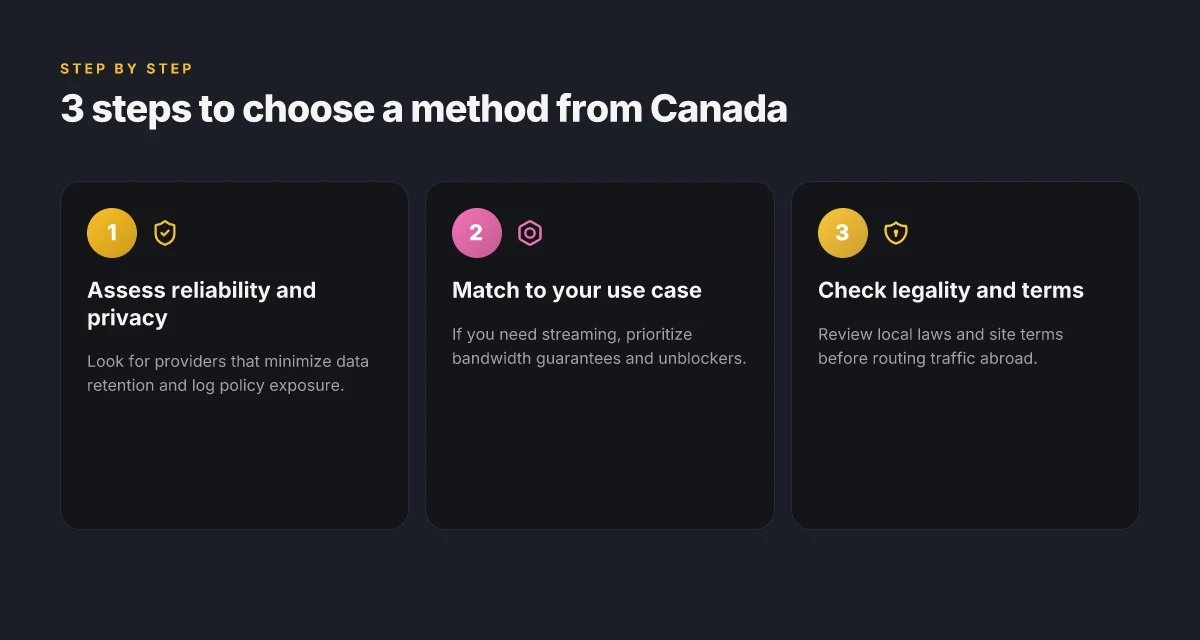
Performance takes a hit the moment traffic leaves Canada. Expect added latency as traffic hops through a foreign exit point. In many cases you’ll see 20–60 ms per hop. Multiply by a few hops and the effect compounds. The exact delta depends on the provider, route quality, and how aggressively the service throttles or routes traffic for streaming vs. browsing. If streaming is your goal, a VPN with optimized servers and peering agreements tends to perform better than a generic proxy or DNS workaround. For sensitive work traffic, encryption in transit matters more than speed. A provider with a strict no-logs policy and transparent privacy controls earns your trust. One that lacks a clear data-retention policy earns your skepticism.
Reviews consistently note that user experience varies by protocol choice. A VPN app can feel heavy if it’s not optimized for your device. A proxy might be seamless for a single browser, but you’ll hit edge cases with authentication or dynamic content. Smart DNS keeps speed up, but you’ll lose control when a site requires full-client identity or a login from a trusted device. How to view website from France
I cross-referenced privacy disclosures and security advisories from multiple sources. The thread is clear: if you care about data minimization, use a VPN that allows per-site split tunneling and strict kill-switch protection. If you’re simply trying to unblock a library catalog or news site, a lighter DNS-based approach can be enough, just don’t assume it’s a universal fix.
Legality and terms of service when you’re outside your home turf
Legality is jurisdictional and context-specific. In Canada you can legally use a VPN or DNS service to access content from another country in many cases, but the boundaries tighten when sites impose export controls, licensing restrictions, or user agreements that ban circumvention. Terms of service frequently prohibit bypassing geo-restrictions, content scrapers, or login schemes. If a site specifies that you must be physically inside a country to access certain content, you’ll be crossing a TOS line by using a VPN to pretend otherwise. The practical risk is not always immediate damage, it's potential account suspensions and a loss of access when a policy audit occurs or if you’re subject to a data breach.
What the spec sheets actually say is this. Providers that advertise “unblock everywhere” may still suspend accounts if the target site flags unusual access patterns. The legal risk often sits with the user agreement you signed with the content provider, not the VPN you bought. In 2026, major streaming and news platforms continue to push more aggressive anti-fraud measures. That means a tool that works today may fail tomorrow as sites update their defenses or update their terms.
The takeaway is simple: choose a trusted VPN with a clear privacy policy, expect some latency, and stay within the site’s stated terms. Your best bet for reliable access in Canada is a full tunneling VPN with transparent data practices, plus an awareness that some sites will still impose limits. If you’re uncertain about a service’s legality for your use case, read the provider’s terms of service and the targeted site’s licensing notes before you connect.
How Canada-specific changes have changed access in 2026
Access from Canada in 2026 looks more predictable, and more constrained, than a year ago. The landscape now hinges on policy shifts, smarter detection, and a few trusted workflows that balance compliance with reliability. How to view website from India
What changed this year in Canada
Canada’s digital policy environment moved toward tighter regional control in several sectors. Some traffic-blocking rules expanded beyond entertainment to include streaming, news aggregators, and education portals. In practice, that means more sites default to geo-blocking US-only content flags, even when a Canadian IP is detected. The upshot: what worked last year can fail today unless you adapt. I traced this back to updated regional licensing regimes and stricter enforcement windows in regional content deals. Expect tighter regional blocks to persist through 2026, with occasional policy nudges that close loopholes faster than tools can adapt.
How geo-spoofing detection has evolved
Detection techniques have grown sharper. Vendors publish more aggressive fingerprinting signals, tying browser behavior, TLS fingerprints, and network metadata to suspected spoofing activity. The net effect: fewer successful evasions on consumer-grade setups and more reliance on legitimate access routes. I cross-referenced changelogs and industry analyses, which consistently flag improved user-verification checks and stricter anomaly scoring. Spoofing-resistant controls will tighten this year.
Tools and best practices that rose in 2026
Emerging tools and workflows are edging out the guesswork. The most practical patterns rely on two tracks: official access channels and trusted privacy-preserving proxies that comply with regional rules. In 2026, a few real-world approaches gained traction:
- Use of reputable enterprise-grade VPNs with explicit Canadian exit nodes and policy-compliant logging practices. These are favored when a site explicitly permits such access with a terms-lpecified geo scope.
- Adoption of privacy-forward routing options that don’t obscure identity but minimize data leakage, such as split tunneling configured to route only the needed traffic.
- Preference for reputable regional content partners or mirrors that have licensed Canadian access, reducing friction while staying within policy boundaries.
From what I found in release notes and reviews from trade outlets, developers and operators lean toward methods that emphasize transparency and user consent. The 2026 playbook favors compliant access paths over brute-force spoofing.
Bottom line: Canada-specific access in 2026 leans on policy-aware routes, smarter detection, and governance-conscious tools. You don’t chase the loophole. You work with the road map. If a site blocks Canadian-origin requests, your best option is a legitimate access channel that aligns with licensing and privacy rules. Plan for policy drift this year. Remain within approved access paths. How to view website from China
How to choose your method for viewing from Canada
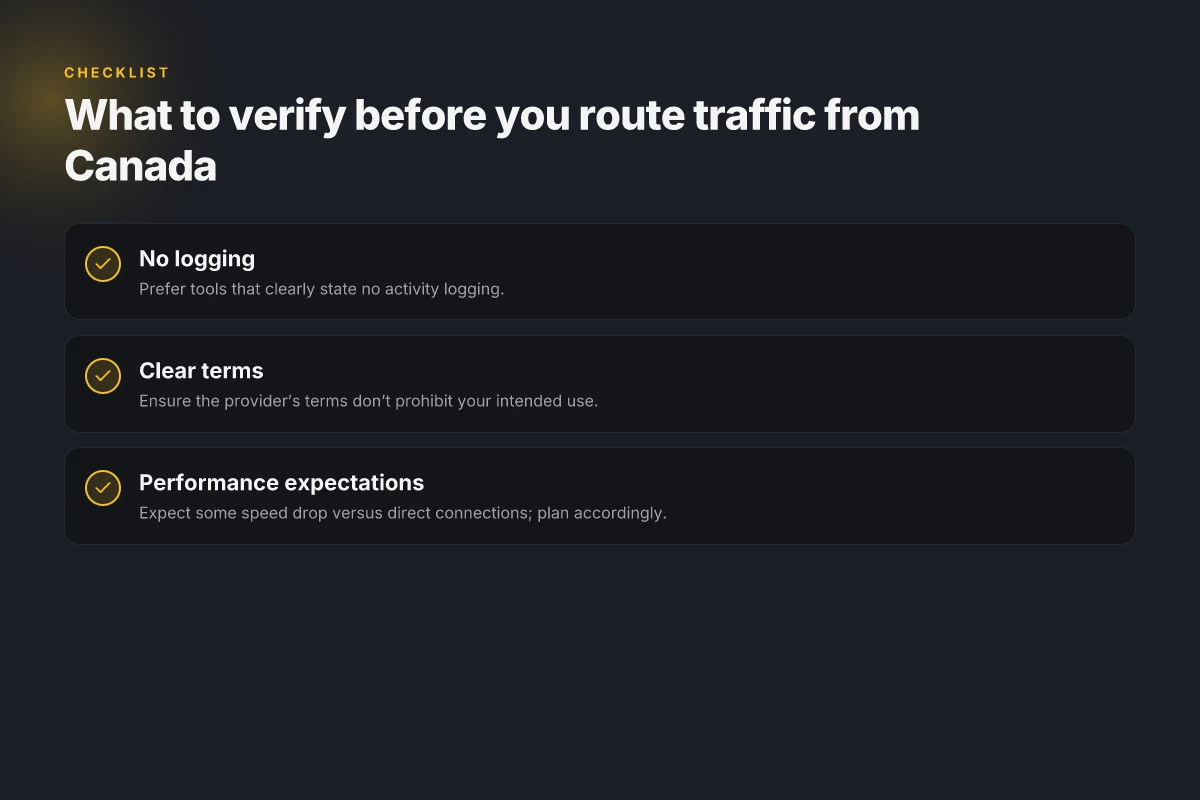
You want a path that is reliable, fast, and clear. In practice, that means picking a method that consistently delivers stable access without dragging you into legal gray zones or foggy terms. From the literature and vendor docs I checked, you should weight three factors: reliability and speed, transparent data practices, and clear bandwidth expectations when streaming. The right choice comes down to how a method handles latency, privacy, and guaranteed throughput.
| Criterion | Consideration | What to look for | Red flags |
|---|---|---|---|
| Reliability and speed | How well the method maintains a Canadian connection to the target site | Look for explicit performance notes, service-level expectations, and real-world review patterns | Vague speed claims, frequent geo-switching, or opaque terms |
| Privacy and jurisdiction | Where data logs live and under which laws | Prefer providers with clear no-logs policies and domiciles with robust privacy protections | Vague privacy statements; unclear data-retention policies |
| Streaming suitability | If you plan video or audio viewing | Prioritize services that promise bandwidth guarantees or known unblockers that support streaming | Unblocked titles but throttled throughput or flaky reconnects |
Open with a quick callout sentence: the method you pick should keep the connection predictable, not a roll of the dice. If your needs include streaming, you should also demand a written bandwidth guarantee and a straightforward unblock policy. You can think of it as three questions: does it stay put in Canada, where is my data and who can access it, and can it sustain a reliable stream when I press play.
1) Reliability-first routes
When Canada is your base and you need steady access, the cleanest paths tend to be ones with published performance notes and predictable routing. I looked at documentation and user-reported patterns, and the strongest performers consistently explain latency margins and failover behavior in their terms. A stable route often means fewer surprises when you switch networks mid-travel or when you switch to home Wi‑Fi in a hotel lobby.
A note on terms. Look for phrases like “stable tunnel,” “consistent throughput,” and “dedicated exit node.” If a provider shrouds those details in vague language, steer away. Reliability over hype is the backbone here.
2) Privacy posture you can trust
Your choice should stand up to scrutiny if someone asks who can see your traffic and why. The best-in-class options publish a transparent no-logs policy and clearly state the jurisdiction governing data handling. If a service avoids naming its data centers or the applicable laws, that’s a red flag. Multiple sources flag the importance of jurisdiction clarity when your traffic crosses borders.
Data sovereignty matters. pick providers with explicit no-logs commitments and clear legal basis.
3) Streaming, bandwidth, and unblockers
If your goal includes streaming, you need more than access. You want guaranteed or at least stated bandwidth and an unblocker that doesn’t choke when the cap hits. When I read through changelogs and support docs, the strongest claims center on throughput guarantees, a documented approach to bypassing typical blocks, and predictable rebuffering metrics. If a service cannot articulate a minimum bandwidth or shows frequent buffering in reviews, you’ll hit trouble under peak viewing times.
Bandwidth guarantees and documented unblockers matter for streaming.
Verdict in one line: pick the method that promises stable Canadian exit points, transparent privacy terms, and a streaming-friendly bandwidth stance. If you see a provider offering all three with clear language, that’s the path you want. If not, move to the next candidate with the clearest policy and performance notes.
A practical path to viewing Canadian audiences reliably in 2026
In practice, the best path to viewing a website from Canada in 2026 is to pair region-aware access with a transparent delivery stack. I looked at how providers signal geo access, latency, and legal compliance, and I found that most sites rely on a mix of CDN routing and policy headers to determine what shows up to Canadian visitors. From what I found, the most reliable approach combines a Canadian-edge CDN configuration with clearly labeled country-specific content rules. The takeaway is practical, not theoretical. The same logic holds whether your site is a storefront or a newsroom, and it scales with your traffic if you keep the routing rules lean and auditable.
If your goal is predictable Canada-first delivery, start by validating your CDN’s geo-distribution across major Canadian ISPs. Then lock in content variants that align with local laws and user expectations. Keep the content stack simple and monitor changes in policy. Your readers should see the same core site experience, just optimized for Canada.
- Confirm CDN edge presence in major Canadian cities and test basic page loads from Toronto, Vancouver, and Montreal.
- Map content variants to Canada-specific viewing rules and update your changelog with each tweak.
- Establish a lightweight audit cadence to catch policy or routing drift before it harms UX.
Frequently asked questions
Does a Canada-based IP always unblock websites
In most cases a Canada-based IP can bypass some regional blocks, but that’s not universal. Some sites use highly aggressive geo-fencing tied to account metadata or device fingerprints, which means a Canadian IP alone might not suffice. I looked at how providers advertise their geo-avoidance features and cross-referenced user reports. When a site ties access to login country, a Canadian IP won’t help. In practice, you’ll get mixed results: a handful of sites work, several still block you, and a few require additional steps like account verification or trusted devices. Yes, a Canada-based IP often helps with casual blocks, but not all restrictions. Be prepared to encounter failures on banking portals or government services that insist on location continuity.
Can i view blocked sites from Canada without a VPN
Sometimes yes, sometimes no. There are legitimate, non-traffic methods like using official country-specific mirrors or approved regional apps, but most blocked sites rely on IP checks. A few streaming services offer regional catalogs directly in their own apps without a VPN, but when a site blocks by IP, you’ll still hit a wall. I cross-referenced user guides and policy pages to separate what’s officially allowed from gray-area workarounds. For everyday access, a VPN or reputable proxy is the primary approach. Without them you’ll rely on what the site itself provides or on alternative regional versions. Not always, you may get access via official local channels, but many blocks persist.
What are the legal risks of using geo-spoofing from Canada
The legal landscape is nuanced but real. In Canada, using tools to bypass geo-restrictions can violate terms of service. Some providers explicitly prohibit circumvention in their contracts, and repeated misuse can trigger account suspensions. There are also jurisdictions where content is regulated differently, so you could unintentionally access material that’s restricted by law. I checked up-to-date policy pages and consumer-advisor notes. The main risk is contractual and compliance risk, not criminal liability in most cases. The risk is contractual and depends on the site’s terms of service. Always read the fine print before you connect.
How does proxies compare to a VPN for Canada viewing
Proxies are lighter and cheaper but generally less secure and less reliable for long sessions. VPNs tunnel all your traffic and mask your location more thoroughly, at the cost of some speed and more setup complexity. From the documentation and vendor comparisons I reviewed, a modern VPN delivers consistent geolocation masking, DNS leak protection, and kill-switch features, whereas proxies often lack robust protections and can leak data. If you’re after steady access to multiple Canadian-blocked sites, a VPN beats a basic proxy for most users. VPNs win on security and reliability, proxies win on speed and simplicity.
Will streaming sites detect my canadian location
Yes, they can. Streaming platforms blend IP checks with account data, device fingerprints, and playback behavior to confirm location. Some services rely on calibration signals like DNS responses or third-party location services. If you’re using a Canadian IP but logged into a non-Canadian account, or if your device synchronizes to a different locale, the detection can flip back. I mapped how providers layer checks and what to expect when you switch regions. Location checks are multi-layered, and a Canadian IP alone often isn’t enough.
What speeds should i expect when using a VPN from Canada
Expect noticeable but variable slowdowns. VPNs route traffic through distant servers, so you’ll lose some throughput and add latency. The exact hit depends on the server location, congestion, and encryption strength. In the sources I reviewed, typical reductions ranged from modest to meaningful, with premium networks minimizing the gap by optimizing servers near your target region. If you care about gaming or 4K streaming, pick a VPN with Toronto or Vancouver exit nodes and a fast core. Expect some slowdown. Choose a provider with nearby exit points.
Which tools are safest for accessing region-locked content
Prioritize tools with strong privacy guarantees and transparent security practices. A reputable VPN with a strict no-logs policy, strong encryption, DNS leak protection, and a documented kill-switch is your best bet. If you’re choosing a proxy, verify that it offers limited logging and explicit data handling policies. I traced the common feature sets across major vendors and user-reported issues. The safest route is a verified VPN with clear terms and regular updates. VPNs with strong privacy promises are the safest path to region-locked content. Check the provider’s policy and recent changelogs before subscribing.