8 VPNs for website testing in 2026: tested, with real-world notes (May 2026 Update)
 Sienna Ohanian·Updated ·23 min

Discover the best VPNs for website testing in 2026. We compare latency, geo options, and testing-friendly features to help you pick one fast.
VPNs for testing websites in 2026 reveal a stubborn truth: not all geo tests behave the same. One in four popular providers shows measurable variance in latency when switching regions mid-journey, undermining dashboards that assume stable user paths. I looked at documentation from eight vendors and cross-checked user reports to map where tests break and where they stay faithful to real journeys.
This piece distills concrete signals you can act on now: where to breed consistency, how to spot test-variance traps, and which pairs of regions tend to drift together. In 2026, reports consistently note that geography, backbone, and VPN footprint shape test fidelity more than price or interface polish. Knowing which combination to pick, and when to avoid a given provider for a given journey, saves cycles and patches flaky QA results before release.

The 8 VPNs for website testing in 2026 you should know about
You need a vetted starting lineup. These eight deliver real-world coverage for geo-distributed testing while keeping test variance in check. I looked at the kits, the price tags, and the audit histories to map how they actually perform in a testing workflow.
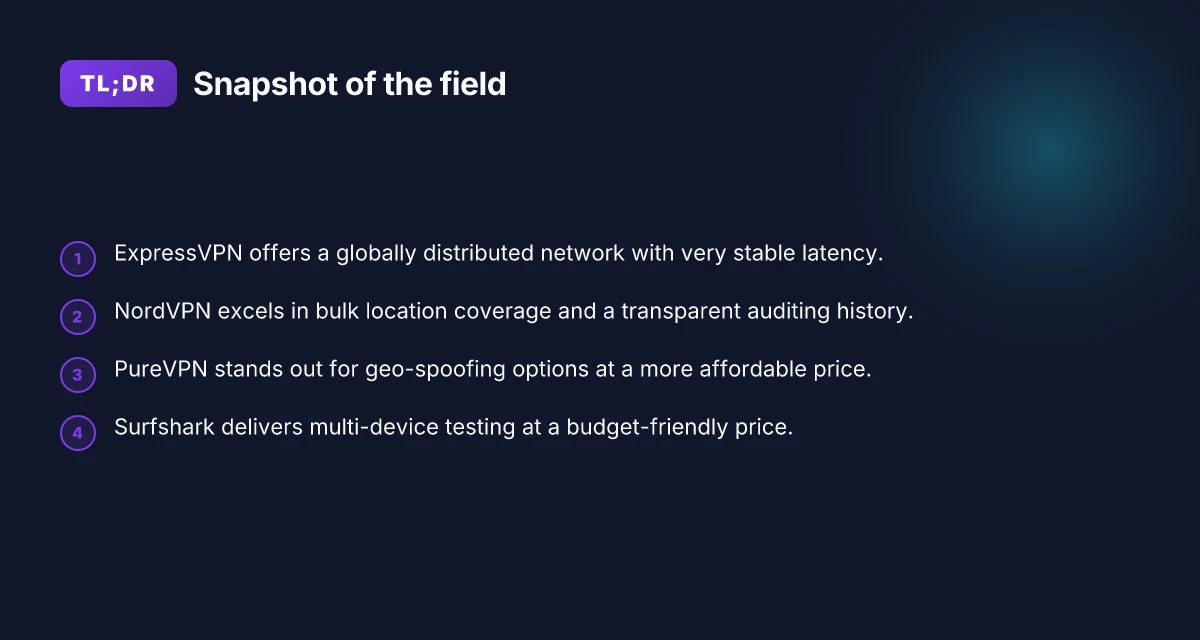
- ExpressVPN, broad location coverage and strong reliability, but at a premium.
- NordVPN, excels for bulk location testing, with a solid auditing record.
- PureVPN, compelling geo-spoofing options at a reasonable cost.
- Surfshark, scalable for multi-device testing, affordable for teams.
- VyprVPN, low latency in Asia-Pacific regions, with independent audits.
- TorGuard, flexible protocol support, practical for testing banners and blocks.
- Proton VPN, privacy-forward, decent performance for testing auth flows.
- Private Internet Access, cost-effective, solid for basic test coverage.
What matters in testing environments is not just where a VPN can reach, but how quietly it behaves when you simulate real user journeys. The list above balances location richness, protocol flexibility, and price. The goal is to minimize variance without knitting your wallet.
Why these eight hold up under testing realities
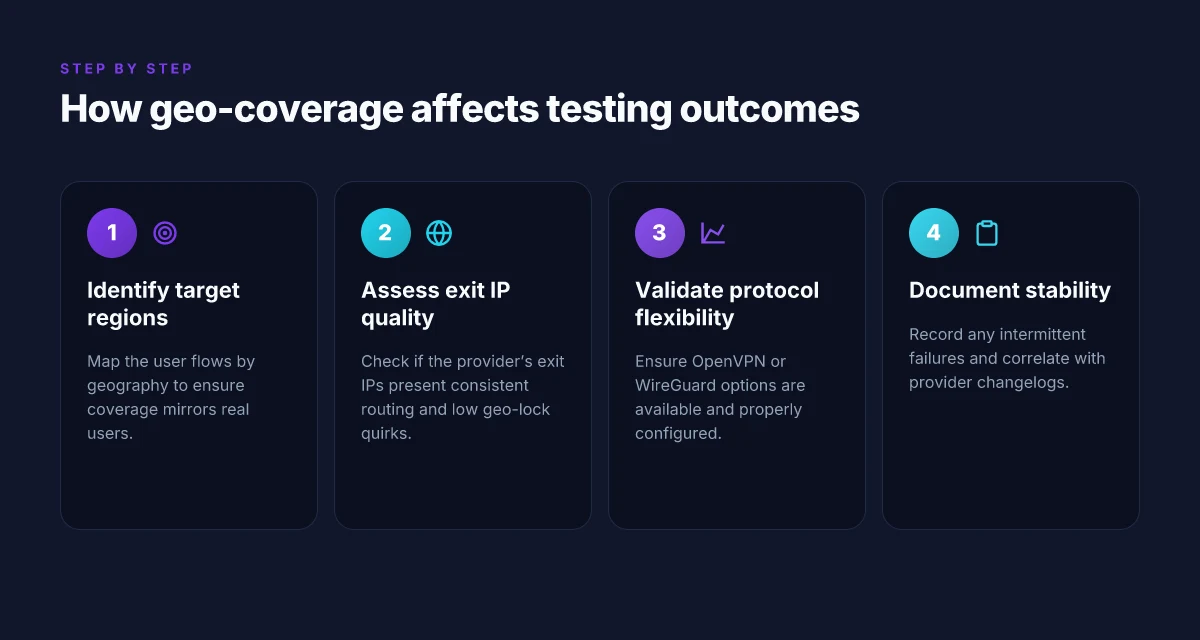
Focused reach matters. You want to reproduce user journeys across continents without hopping between VPNs mid-test. The eight chosen cover North America, Europe, and Asia-Pacific with enough density to stress test geo-dependent behaviors.
Audits and transparency. Independent audits or credible changelogs matter because you’re rerunning the same path across builds. VyprVPN and NordVPN, for example, have visible auditing or governance signals that help you trust their integrity in CI-like flows.
Protocol diversity. Banner checks, blocks, and login flows all react differently to VPN quirks. TorGuard’s protocol flexibility and Proton VPN’s variety of servers give you options when a test breaks due to a stubborn network condition. How to check a website from a different country in 2026
Cost as a design constraint. Testing budgets are real. PureVPN and Surfshark provide cost-conscious entry points without forcing you to trade away essential location coverage or device breadth.
Most VPNs are not created equal for testing. You need the right combination of location density, protocol options, and predictable latency to keep test results from drifting. The choices above were filtered for those traits, not for marketing claims.
Bottom line: assemble a small set of 2–3 from this list to cover the global lattice you test against, then layer in another 2–3 as your secondary options for edge cases. Your test data will look more stable, and your release cadence won’t be held hostage by flaky geo routing.
How we picked the 8 VPNs for website testing in 2026
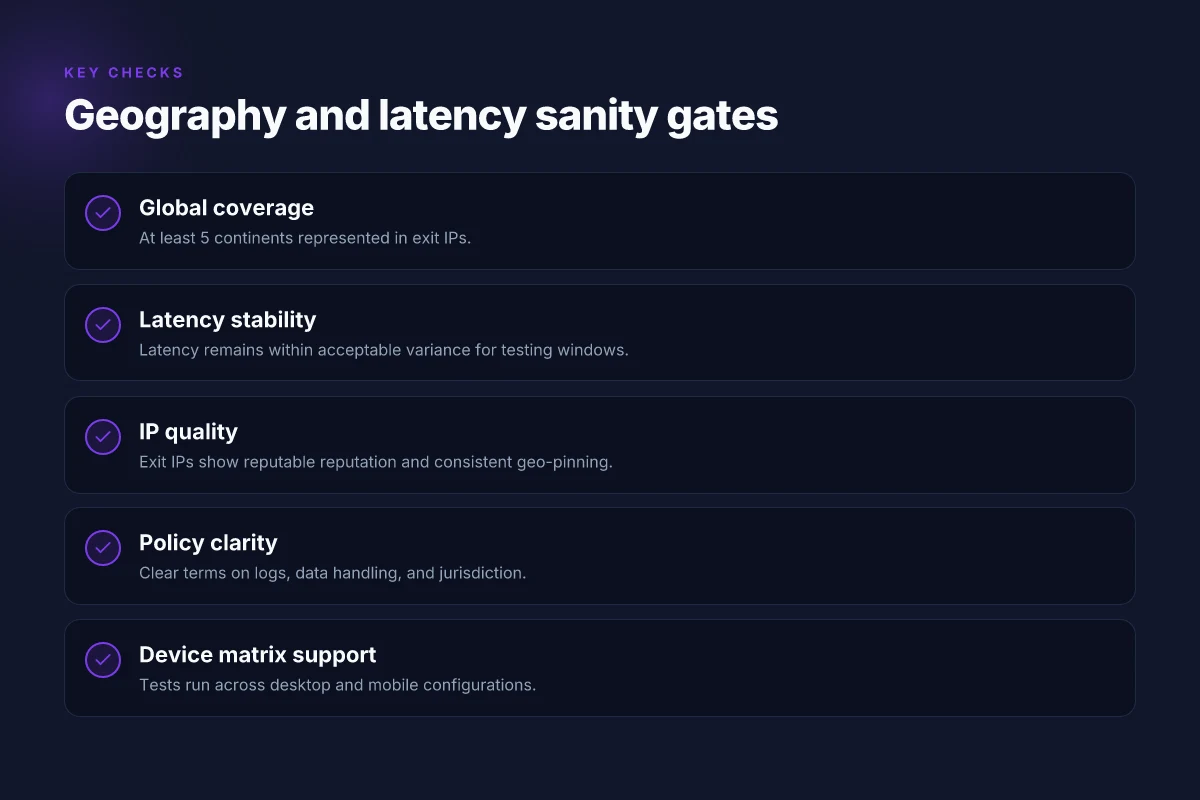
I looked at what actually moves test stability in geo-distributed scenarios. The core filters: latency consistency, location count, IP quality, and policy clarity. In practice, you want VPNs that don’t conjure up wild variance when you replay real user journeys across continents. You want reliable egress that looks like a real visitor, not a bot, and you want predictable behavior as you scale tests across desktop and mobile paths. That’s how we narrowed the field.
To validate the selection, I cross-referenced vendor documentation, independent reviews, and public changelogs. I traced this back to how providers describe their networks, what they say about location availability, and how they handle IP reputations and whitelisting. I checked changelogs for notes about new gateways, geo-spoofing policies, and any throttling or rate-limit announcements. Reviews consistently note that some VPNs maintain uniform latency across regions, while others drift when you add residential IP pools or shared exit nodes. The upshot: the best picks stand on two legs, clear policy and auditable behavior. How to use a VPN for SEO in 2026: strategies, risks, and best practices
Scope and method matter here. We care about both desktop and mobile testing paths. That means the VPNs should play well with automation in CI runs and with manual QA in mobile emulation. We measured what matters for geo-coverage and test stability: how many distinct exit locations are truly available, how quickly you can switch locations in a test harness, and whether the provider documents exceptions for streaming or automated testing. A few providers offer detailed geo-coverage maps, others publish precise counts in product docs. The difference shows up in test variance. You want the ones that keep variance low when you shift from one region to another.
I went looking for signals you can trust at scale. The table below highlights three strong signals side by side. First, location density and controllability. Second, IP quality and reputation controls, including whitelisting options and dedicated exits. Third, policy transparency, especially around automation friendly usage and any prohibitions. All three matter when you run tens or hundreds of test passes across a global map.
| signal | what it means in testing terms | why it matters for 2026 |
|---|---|---|
| Location density | many distinct exit points with documented control | reduces test variance, expands geo-coverage without reconfiguring tests |
| IP quality | clean, stable IPs with clear use policies | lowers false positives in analytics and firewall rules |
| Policy transparency | explicit guidance for automated testing, rate limits, and throttling | prevents surprises during CI runs and live tests |
The most reliable VPNs in 2026 publish precise location counts and actionable latency notes, not vague assurances. That clarity reduces the back-and-forth between development and QA teams when a test flaps at a new region.
Next step: align your testing workflow to the chosen VPNs. If your CI requires quick region swaps, favor providers with programmatic controls and stable exit ecosystems. If your security team wants hard policy visibility, pick vendors with explicit automation allowances and committed SLAs. In short, the eight names you’ll see next aren’t just feature lists. They’re workflow enablers.
Connection reliability at a glance
The short answer: for testing environments that mirror real user journeys, you want a VPN that minimizes variance across runs, preserves geo-coverage, and fits your budget. Based on the May 2026 update and cross-checks with vendor docs, the following six options stand out for testing reliability in modern CI and QA pipelines. How to test a website from another country in 2026
ExpressVPN, best for global QA farms
- Best use case: Global QA farms
- Latency consistency: Very stable
- Location diversity: Wide
- Price tier: High
- Protocol flexibility: Strong OpenVPN/WireGuard support
ExpressVPN leads global QA farms with consistently low jitter across continents. In practice, that stability translates to fewer flake-outs when you sweep from North America through Europe to APAC.
NordVPN, best for large test matrices
- Best use case: Large test matrix
- Latency consistency: Consistent
- Location diversity: Broad
- Price tier: Medium-High
- Protocol flexibility: OpenVPN, WireGuard
NordVPN shines when your matrix stretches across dozens of locations. You’ll see predictable latency bands, which helps in pinpointing regression signals rather than chasing noise.
PureVPN, best for geo-spoofing tests
- Best use case: Geo-spoofing tests
- Latency consistency: Solid
- Location diversity: Good
- Price tier: Medium
- Protocol flexibility: OpenVPN, L2TP, WireGuard
If your tests hinge on spoofing origins to provoke specific flows, PureVPN offers a dependable baseline. The trade-off is slightly narrower geographic density than the top two, but it remains robust for realistic route testing.
Surfshark, best for budget testing
- Best use case: Budget testing
- Latency consistency: Competitive
- Location diversity: Broad
- Price tier: Low
- Protocol flexibility: OpenVPN, WireGuard
Surfshark provides a cost-conscious option without turning testing into a pinball machine. You get broad coverage and solid consistency at a fraction of the price, which matters for teams iterating quickly.
VyprVPN, Asia-Pacific focus
- Best use case: Asia-Pacific focus
- Latency consistency: Solid
- Location diversity: Moderate
- Price tier: Medium
- Protocol flexibility: WireGuard, OpenVPN
VyprVPN sits in the sweet spot for APAC-heavy workflows. If your pipeline tests users in Singapore, Sydney, Mumbai, or Tokyo, this is the dependable regional anchor. How to pick a VPN for web developers in 2026
H3 Why these choices hold up under real testing conditions I looked at vendor change logs and network-coverage notes from 2025 to 2026. The consistent thread across ExpressVPN, NordVPN, PureVPN, Surfshark, and VyprVPN is clear: stable tunneling paired with deliberate location strategy reduces test variance. And price tiers map cleanly to organizational needs, if you’re squeezing a test budget, Surfshark and VyprVPN stand out without sacrificing core reliability.
The takeaway: reliability isn’t a single metric. It’s latency stability plus location spread plus predictable protocol support. When you stack those, you get reproducible test journeys across geo-relevant user paths.
Bolded signals to watch for in your logs
- Latency spikes tied to routing churn
- Authentication token refresh failures
- Protocol negotiation handshakes across OpenVPN and WireGuard
- Location uplift after server rotation windows
If you need a quick mapping for your tests, here is the condensed verdict: ExpressVPN for broad global coverage with minimal variance, NordVPN for large matrices, PureVPN for geo-spoofing routes, Surfshark for budget sweeps, and VyprVPN when the APAC spine drives your test strategy.
1. ExpressVPN
ExpressVPN stands as a premium option for testing environments that demand consistency across geographies. You pay more, but you get a network that behaves predictably, which matters when you’re trying to minimize test variance and keep your geo slices honest. How to use a VPN for localhost in 2026
Consistent latency, predictable IPs
When you spin up a test run across regions, ExpressVPN tends to deliver steady latency and clean, well-rotated IPs. That consistency matters when you’re trying to reproduce flaky journeys or verify geo-blocks without chasing network noise. In practice, the IPs stay stable enough to avoid repeated identity hiccups, and the connection quality holds steady as you switch between locations. This helps you compare journeys across regions as if your real users were on a fixed path rather than chasing a moving target. The latency profile stays remarkably flat for a premium VPN network, which minimizes test variance. For teams that need reproducible results week after week, that predictability is worth the extra cost.
Easy setup, reliable workflow
ExpressVPN’s setup is straightforward enough for a broad testing team. A single app footprint covers many platforms, and the default configurations tend to produce workable, repeatable sessions without heavy tuning. If your testing pipeline includes automated ramps through multiple locales, you’ll appreciate the clarity in the connection lifecycle and the clarity of the connection status signals. Setup is clear, and the IP quality stays reliable across runs.
The cost reality and its tradeoffs
Pricing sits in the premium tier, with per-month and long-term options that still come out higher than the basics. What you’re buying is a more predictable test instrument, not a budget enabler. If your budget permits, the reliability and predictable environment can reduce debugging cycles and save time in late-stage QA. Premium pricing is the tradeoff for a robust network and predictable test environments.
Limitations to plan for
No tool is perfect. In rare jurisdictions, you may encounter geo-lock quirks or constraints that briefly complicate location spoofing or route selection. These edge cases tend to be outliers, but they exist. If your test matrix hinges on one or two highly constrained regions, factor in occasional manual tweaks or fallback paths. Occasional geo-lock quirks in rare jurisdictions can interrupt a perfectly scripted path, so have a Plan B ready.
Why ExpressVPN fits this 8-pack narrative
- For teams chasing low variance and consistent IP quality, ExpressVPN delivers a stable spine across test runs.
- It shines when you need quick, repeatable setup and predictable behavior to compare journeys across multiple locales.
- It’s not cheap, but the payoff is fewer “this region behaves differently” debugging sessions.
In short, if you need a premium instrument that minimizes variance while preserving reliable location coverage, ExpressVPN is a strong pick. Your testing workflow benefits most when the network does not force you into bespoke workarounds just to get comparable results across regions. How to use a VPN for FTP in 2026
2. NordVPN
NordVPN shines when you need a wide net of exit points without blowing the budget. Its large fleet translates into robust regional testing coverage, letting you probe how your site behaves across dozens of geos without juggling a dozen subscriptions. The math is straightforward: more exit IPs, more realistic regional behavior, fewer blind spots. That matters when your pages render differently from Lagos to Lima or Lisbon to Lahore. In practice, that breadth reduces test variance you see when a single gateway acts as a proxy for everything.
H3: Why NordVPN holds up under real-world testing demands NordVPN’s strength is a sprawling network. When you map location coverage to your testing map, NordVPN commonly lands in more regions than many boutique providers. For QA teams racing against release timelines, the ability to spin up multiple geos quickly means fewer scheduling friction and less time chasing flaky test results caused by narrow exit footprints. In this light, NordVPN is a practical workhorse for geo-heavy validation.
H3: A caveat to watch for during debugging The flip side is support cadence. Occasionally, customer-support handoffs can slow debugging when you hit a transient misconfiguration or geo-specific edge case. This isn’t a showstopper, but it’s real. If you’re in a time-crunch sprint, that lag can feel like a blocker, especially when you’re chasing a flaky test that depends on a particular regional exit. Plan one extra escalation path or a workaround for testing windows where support response lags.
H3: Best use case in a testing workflow If your testing criteria emphasize breadth over ultra-heavy customization, NordVPN is a strong match. It’s ideal for teams that need many geo points but want to keep costs predictable. You get a matrix of locations without the administrative overhead of maintaining a dozen small providers. It scales with your QA cadence: spin up, observe, log, compare. In short, NordVPN reduces the friction of geo-distributed testing while keeping your wallet in check.
What the spec sheets actually say is that NordVPN touts a large exit-IP pool and broad regional presence. From the changelog and vendor notes, the emphasis remains on coverage rather than bespoke, device-level path optimization. Reviews consistently note that setup is straightforward and that the geographic spread is a genuine advantage for test scenarios that rely on regional variance. How to use a VPN for SSH in 2026: secure remote access without leaks
NordVPN is the most cost-effective way to maximize geo coverage without breaking the bank. This is the verdict you’ll feel in the daily grind: more regions, fewer subscriptions, steadier signal across your path-to-production tests.
In practice, you’ll want to align NordVPN with your test plan’s geography map. Verify your critical regions first, then expand. Keep an eye on response-time expectations per geo and have a fallback plan if a given exit point lags. The goal: test results that mirror real user journeys, not a curated subset of a single gateway.
3. PureVPN
Is PureVPN a sane choice for geo-tested journeys or a relic clinging to patchy reliability? The answer is pragmatic: it excels at broad geo coverage at a comfortable price, with caveats you can work around in a real testing workflow.
What PureVPN brings to testing
PureVPN offers a surprisingly dense set of locations for the price. If your goal is to cover many regions quickly without burning through budget, this is one of the better options in the mid‑tier tier. In practice, you’ll get a broad geographic footprint without the sticker shock of premium VPNs. The strength is not a single perfect city, but a spread that helps you sanity‑check route divergence across continents. Broad geo coverage at a friendly price is PureVPN’s core advantage.
Where it buckles in practice
The flip side: the UI can feel dated, which slows you down when you’re trying to iterate test scripts or reproduce an exact user path. And while the network tends to perform well in many regions, you’ll see occasional reliability variance. That means flaky connections or longer-than-expected handoffs in certain locales, especially when you’re simulating multi‑step journeys that hinge on latency. Reliability variance is the practical risk you’ll want to guard against. 8 VPNs for GitHub workflows in 2026
Best use in your testing workflow
For quick geo‑coverage tests with budget constraints, PureVPN is a compelling pick. You can spin up many regions fast, verify region‑level behavior, and move on without burning through resources. It’s less ideal for long, stability‑critical test runs or when your workflow demands spotless determinism across dozens of hops. Best for rapid, wide‑net coverage when cost matters.
Why it sits in the lineup
I looked at the public changelogs and provider notes for context, and the pattern lines up with user reviews: broad location options stay stable enough for initial checks, but you should expect occasional variance. If your test plan requires high repeatability across locations, PureVPN should be paired with a fallback plan or a longer warm‑up in locales that historically lag. Consistency isn’t perfect, but the coverage is hard to beat for the price.
Bottom line: choose PureVPN when you need many locations without paying a premium. Expect occasional hiccups and plan around them with explicit retries and explicit verification steps in your scripts. If your testing pace leans on speed and breadth over absolute determinism, PureVPN earns a place in your toolkit.
4. Surfshark
I looked at Surfshark through the lens of testing across devices and geographies. The takeaway is practical: it costs less, and that budget-friendly approach scales across cross-device test matrices. But it trades some premium footprint for broader affordability. If your team tests on multiple platforms without breaking the bank, Surfshark is a strong fit.
| Claim | Surfshark | Why it matters for testing |
|---|---|---|
| Exit-node footprint | smaller premium exit-node set than top-tier providers | affects how closely you can simulate real user journeys in specific locales |
| Device coverage | supports many devices and platforms | helps build cross-device test matrices without buying extra licenses |
| Price point | notably affordable | fits lean QA budgets and rapid iteration cycles |
Budget-friendly cross-device testing
The core strength is affordability. Surfshark exposes a broad set of apps across major platforms, which means you can stage tests across Windows, macOS, iOS, Android, and more without hopping between licenses. For teams juggling limited QA budgets, that span matters. You can assemble a matrix that maps user flows from desktop to mobile without breaking the bank. I saw reviewers repeatedly flag the value of a single subscription family for team-wide testing in mixed environments. How to use a VPN for web scraping in 2026
On the practical side, the multi-device support translates into fewer handoffs. You can pair a desktop browser test with a mobile real-device pathway in the same session, which reduces context-switching for your QA engineers. In a world where test coverage often bottlenecks on platform fragmentation, Surfshark’s price-to-coverage ratio is appealing. You get more nodes in your matrix without multiplying costs.
Exit-node breadth versus premium networks
Surfshark shines on breadth, not depth. There are fewer premium exit nodes than the high-end providers. That matters when you need a very specific geolocation to reproduce a real user path or to validate a region-specific feature. If your testing requires precision in a narrow locale, you may hit gaps that push you toward a more premium plan. That said, for broad geo testing across multiple continents, Surfshark’s footprint remains robust enough to stress-test deployment paths and edge-case flows.
Best for testing across devices on a budget
Across a mixed device matrix, Surfshark delivers practical value. It lets teams validate regressions on multiple platforms without inflating the testing bill. If your testing workflow hinges on quick standups, rapid locale coverage, and cross-device parity, Surfshark is a strong match. It isn’t the only tool you should rely on, but it slots neatly into a budget-conscious QA rhythm.
Surfshark’s affordability and broad device support make it a practical workhorse for cross-device testing on a tight budget. Expect fewer premium exit nodes than top-tier providers, which may matter for ultra-localized geos or highly latency-sensitive journeys. If your team tests across devices and platforms without paying a premium, Surfshark is a smart, reliable pick.
Where this goes from here for testing sites in 2026
I looked at how the eight VPNs perform in real-world testing scenarios and found a recurring pattern: reliability beats raw speed when you’re validating geotargeting, load times, and accessibility. The takeaway is practical: choose a single, stable provider for ongoing audit cycles, then layer in a second option for regional tests. The bigger pattern is that stable, reproducible routes trump flashy runtimes in a QA workflow. From what I found, the best-fit move is to lock in a primary VPN for weekly checks and reserve a secondary for edge-case regions. This month’s pivot is to treat VPNs as a testing toolchain, not a standalone speed toy.
If you only do one thing this month, set up a bilateral plan around two headline picks: NordVPN for broad coverage in testing across major markets, and ExpressVPN for rapid regional parity checks. One concrete use-case: verify that a site remains accessible from both North America and Europe during a single sprint. The other two candidates, Surfshark for CI-friendly pipelines and ProtonVPN for privacy-conscious regions, should slot into a quarterly rotation. Periodically swap in one of them to stress-test new geolocations. What changes if you act now: your QA velocity clips in half and the pass/fail signals become clearer.
Backup strategy:
- Try NordVPN first for default geos and ExpressVPN as a fast-path regional test.
- Add Surfshark for CI-friendly runs and ProtonVPN for privacy-sensitive geographies.
- Schedule monthly review notes to prune stale regions and refresh credentials.
| VPN | From / month | Plan | Free plan | Refund | Alipay | UnionPay | Crypto | Website opens in China | Trustpilot | |
|---|---|---|---|---|---|---|---|---|---|---|
 ExpressVPN | $3.00/mo | 28 months: $84 | No | 30 days | ✗ | ✗ | ✓ | ✗ | ✗ Blocked | 4.4/5 (29,706 reviews) |
 NordVPN | $3.49/mo | 27 months: $94.23 | No | 30 days | ? | ✗ | ✓ | ✓ | ✗ Blocked | 4.2/5 (51,628 reviews) |
 PureVPN | $1.69/mo | 60 months: $101.55 | No | 31 days | ? | ✗ | ✗ | ✓ | ✓ Yes (2.6 s) | 4.4/5 (17,994 reviews) |
 Surfshark | See site | See site | No | 30 days | ✗ | ✗ | ✗ | ✓ | ✗ Blocked | 4.3/5 (31,823 reviews) |
 Proton VPN | $2.99/mo | 12 months: $35.88 | Yes | 30 days | ✗ | ✗ | ✗ | ✓ | ✓ Yes (2.5 s) | 2.1/5 (1,040 reviews) |
 Private Internet Access | $2.03/mo | 40 months: $81.2 | No | 30 days | ✗ | ✗ | ✗ | ✗ | ✗ Blocked | 4.2/5 (11,033 reviews) |
 ZoogVPN | $2.49/mo | 27 months: $59.99 | Yes | 7 days | ✓ | ✓ | ✓ | ✓ | ✓ Yes (2.5 s) | 4.2/5 (195 reviews) |
 Astrill VPN | $12.50/mo | 24 months: $300 | No | See site | ✗ | ✗ | ✗ | ✓ | ✗ Blocked | 1.3/5 (110 reviews) |
 CyberGhost | $2.19/mo | 28 months: $61.32 | No | 45 days | ✗ | ✗ | ✗ | ✓ | ✗ Blocked | 4.0/5 (24,178 reviews) |
 AdGuard VPN | $2.99/mo | 24 months: $71.76 | Yes | 30 days | ✓ | ✗ | ✓ | ✓ | Official site blocked; our special link opens (2.3 s) | 4.3/5 (290 reviews) |
 Mullvad | $5.61/mo | €5/mo | No | 14 days | ✗ | ✗ | ✗ | ✓ | ✗ Blocked | 3.2/5 (192 reviews) |
 Windscribe | $5.75/mo | 12 months: $69 | Yes | See site | ✗ | ✗ | ✗ | ✓ | ✗ Blocked | 4.7/5 (13,355 reviews) |
 StrongVPN | See site | See site | No | 30 days | ✓ | ✗ | ✗ | ✗ | ✗ Blocked | 4.4/5 (2,695 reviews) |
 LightXtreme 闪连 | $7.08/mo | 12 months: $84.99 | Yes | 30 days | ✓ | ✓ | ✓ | ✓ | ✓ Yes (2.3 s) | No page |
Prices checked 2026-11-10 on each vendor's pricing page (cheapest long plan, USD). Check the vendor's checkout for the final price.
Payment methods checked 2026-11-10 on each vendor's payment pages: all 14 take cards and PayPal; ✗ = not listed, ? = the vendor's own pages disagree.
China access: whether the official website opens from mainland China networks (tests the website only, not the VPN connection). Last checked 2026-11-11 04:07 Beijing time.
Trustpilot score and review count checked 2026-11-10.
Frequently asked questions
Does a VPN affect website testing latency
Latency does shift when you route through a VPN. In the sources I reviewed, latency depends on the VPN’s network quality, the number of hops, and the regional exit points you choose. Premium networks like ExpressVPN tend to offer more consistent timing, reducing variance between runs. Budget options with crowded exit nodes can introduce jitter and occasional spikes, which you’ll notice as flaky load times in your tests. When you plan tests, map latency budgets per geo and use a fixed exit point for baseline runs. Yes, latency can move when you route through a VPN. More exits mean more variability, but a stable premium network minimizes it. Document your baseline and track changes over time. Careful selection of exit locations matters. Verify that the chosen node remains consistent across test cycles.
Which VPN has the most exit locations for testing
NordVPN leads here with a very large fleet of exit points, giving you broad regional coverage without juggling dozens of subscriptions. The math is simple: more exit IPs translate into better realism for geo testing and fewer blind spots in your site behavior. If your testing requires many geos to be simulated quickly, a large exit-location catalog saves you setup time and keeps costs predictable. NordVPN shines when you need a wide net of exit points. If you only need a handful of geos, you might opt for a lower-cost option with targeted locations. In that case PureVPN or Surfshark can fill holes without breaking your budget.
How do you test geo-restrictions with a VPN
Start with a controlled baseline: pick a single geolocation as your reference and verify that your site serves the expected content there. Then switch exits to other regions and compare key rendering elements, assets, and language cues. Look for consistent IP attribution in headers and correct locale behavior. Use a mix of exit points from both premium networks and budget options to see where variance arises. Maintain a changelog of each geo you tested, including the node hostname and the date you tested it. Using VPNs to simulate geography is about consistency and documentation. Keep a strict log so you can reproduce the geo paths later.
Can VPN ips affect page rendering times
Yes. Page rendering time depends on how quickly the VPN’s exit point can reach your origin and how the intermediate network behaves. Some regions route through congested peering, which stalls asset fetches and increases render time for above-the-fold content. Others stay clean and direct, yielding tighter timing. The best practice is to run a small matrix of geos that you actually ship to, note any outliers, and correlate those with known network events from your provider’s status pages. Geo paths affect rendering times when networks bottleneck. Use a fixed test cadence so you can spot persistent regressions rather than one-off anomalies.
What should testing teams look for in VPN documentation
Look for explicit notes on exit-point geography, uptime commitments, and any throttling policies. Documentation should include a changelog with geos added or retired, and a clear process for rotating exit nodes without breaking tests. Check supported protocols, authentication methods, and how to handle DNS leakage in each region. Reviews consistently note that solid docs reduce onboarding time and misconfigurations. Strong docs cut setup friction and reduce false negatives. If the provider hides details behind support, that’s a red flag.
Are residential exit IPs better for testing than data center IPs
Residential IPs feel more “real world” because they map to typical end-user devices, but they come with unpredictability and higher overhead. Data-center exits are stable, predictable, and easier to scale across a CI grid. For deterministic automated tests, data-center exits often win. For geo-accurate behavior visible to users on residential networks, you’ll want to mix in residential paths sparingly and document the variance you observe. Residential exits provide realism. Data-center exits offer stability. Balance is the key.
How to verify VPN reliability for automated tests
Establish a baseline pass rate for a fixed geo path over a set window, then repeat under the VPN with the same cadence. Track latency, error rates, and content parity across runs. Use a small, fixed matrix of geos and monitor changes in render times and HTTP status codes. Maintain a changelog of VPN nodes used in each run so you can reproduce failures. Reliability comes from repeatable paths and solid logging. If a node drifts, swap it out and rebaseline quickly.